About the data
Sources, not affiliations.
Organisations and institutions whose records this site cites
This is a list of sources. This publication is independent, has no institutional affiliations and no role in any of the programmes described elsewhere on the site; the bodies below appear because their published records are what the jurisdiction dataset is built from. Each entry says what the institution maintains and which part of this site depends on it.
Why a source list rather than a partner list
The distinction is not pedantry. A reference work that lists institutions under a heading implying association borrows their authority without their involvement, and a reader who takes the list at face value would credit conclusions here to bodies that have never seen them. Every claim on this site stands on a named document with a check date, which is a stronger basis than an affiliation would be, and it is verifiable by following the citation rather than by trusting the publisher.
It also matters for what the site is allowed to say. Describing a programme run by another institution is straightforward reference work; implying a role in it is not, and the line between the two is exactly the line this page draws.
The institutions
| Institution | What it maintains | What this site draws from it |
|---|---|---|
| United Nations Office on Drugs and Crime UNODC | Custodian of the drug-control and organised-crime conventions, and publisher of the legal library that reproduces national legislation. | The single largest source of confirmed national instruments on this site, and the source for two programme dossiers. |
| United Nations Treaty Collection UNTC | The depositary record of signatures, ratifications and accessions. | Every ratification date on every jurisdiction record, taken from the status tables for the four relevant chapters. |
| Financial Action Task Force FATF | Sets the international standards on money laundering and terrorist financing and publishes the monitoring lists. | The listing status on every jurisdiction record and the whole of the grey-list tracker. |
| World Customs Organization WCO | The customs standards body, and lead on general aviation monitoring work. | The source for one programme dossier. |
| INTERPOL | Operates the international police cooperation channels and the firearms records system. | The source for the iARMS dossier. |
| Organization of American States OAS | Regional organisation whose legal repository holds Caribbean and Latin American instruments. | Confirms several national instruments where no national portal publishes them. |
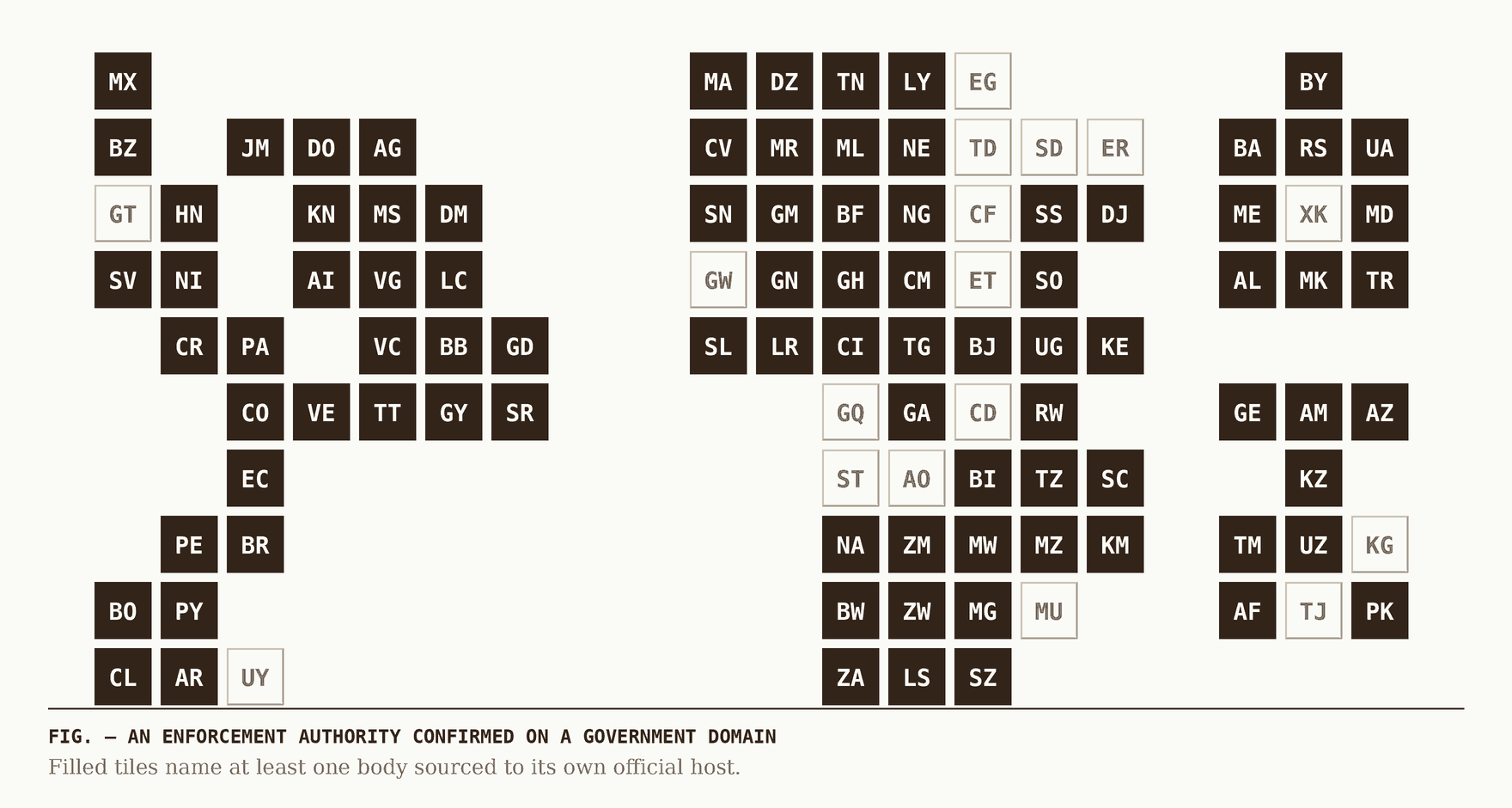
| National law registers, gazettes and parliamentary repositories | The primary publishers of a state's own legislation. | Cited directly on the records they confirm. 129 distinct official hosts are cited across the enforcement-authority fields alone. |
Programmes described on this site
17 international programmes have dossiers here. They are described from published material and each dossier names the official source that documents it; none of them is operated by this publication. The full set is at the programme index, and the sourcing rules that apply to every page are set out under sources and methodology.
Questions
Does this site have partners?
No. This is an independent reference publication with no institutional affiliations, no funding relationship with any of the bodies listed on this page, and no role in any of the programmes it describes. The institutions here are sources whose published records the site cites.
Why is the page at this address then?
Because the address was in use and is still referenced from outside, and a URL that once meant something should resolve to something honest rather than to an error. What changed is the content: a list of institutions this publication cites, not a list of institutions it works with.
What makes a source usable here?
That it is published by the body with authority over the fact, and that it can be pointed at. A depositary table is usable for a ratification date because the depositary keeps the register; a national gazette is usable for a statute because the state enacted it. A secondary summary of either is not, however reliable it may be, because a reader cannot check the claim without leaving the chain of custody — which is why several fields on this site are empty rather than filled from an aggregator.
How are these sources chosen?
By what they publish rather than by reputation. A body appears here because it maintains a record this site draws on — a depositary table, a legal library, a plenary statement, a national gazette — and each citation on the site names the specific document and the date it was checked, so any claim can be traced back without going through this page.