Programme dossier
Led by European Union.
ECO-SOLVE: Innovative solutions against environmental crime
Environmental crime treated as a data problem: the trade is largely online, and what is missing is the means to read it at scale.
What it addresses
Environmental crime enters this subject through the same door as everything else on it. The official description is direct about why it belongs here at all: it is a major contributor to the growth of serious criminal activity and provides a soft entry point into global illicit flows for traffickers — a lower-risk, lower-penalty route into the same corridors, intermediaries and documents that carry narcotics and weapons. What distinguishes it operationally is where the trade happens. A great deal of it is conducted openly online, which makes it observable in a way a container is not, and unobserved in practice because nobody was reading the listings.
How it works
The project monitors the online trade and extracts data from it in a form law enforcement and regulators can act on, and pairs that with investigation of the politicians and private actors who facilitate the flows rather than only the sellers. A third strand works to carry community perspectives into local policing strategy and into multilateral forums, on the reasoning that the communities exposed to organised environmental crime are also the ones positioned to change it. Activities are aligned with the Europol-led European Multidisciplinary Platform Against Criminal Threats, which is the coordination structure the enforcement side of this already runs through.
Where it applies
ECO-SOLVE is not tied to a geographic corridor. It is shared infrastructure, available to any participating jurisdiction, and its usefulness in a given place depends on what that jurisdiction contributes to it rather than on where it sits. The obligations that determine that are set out on the firearms page.
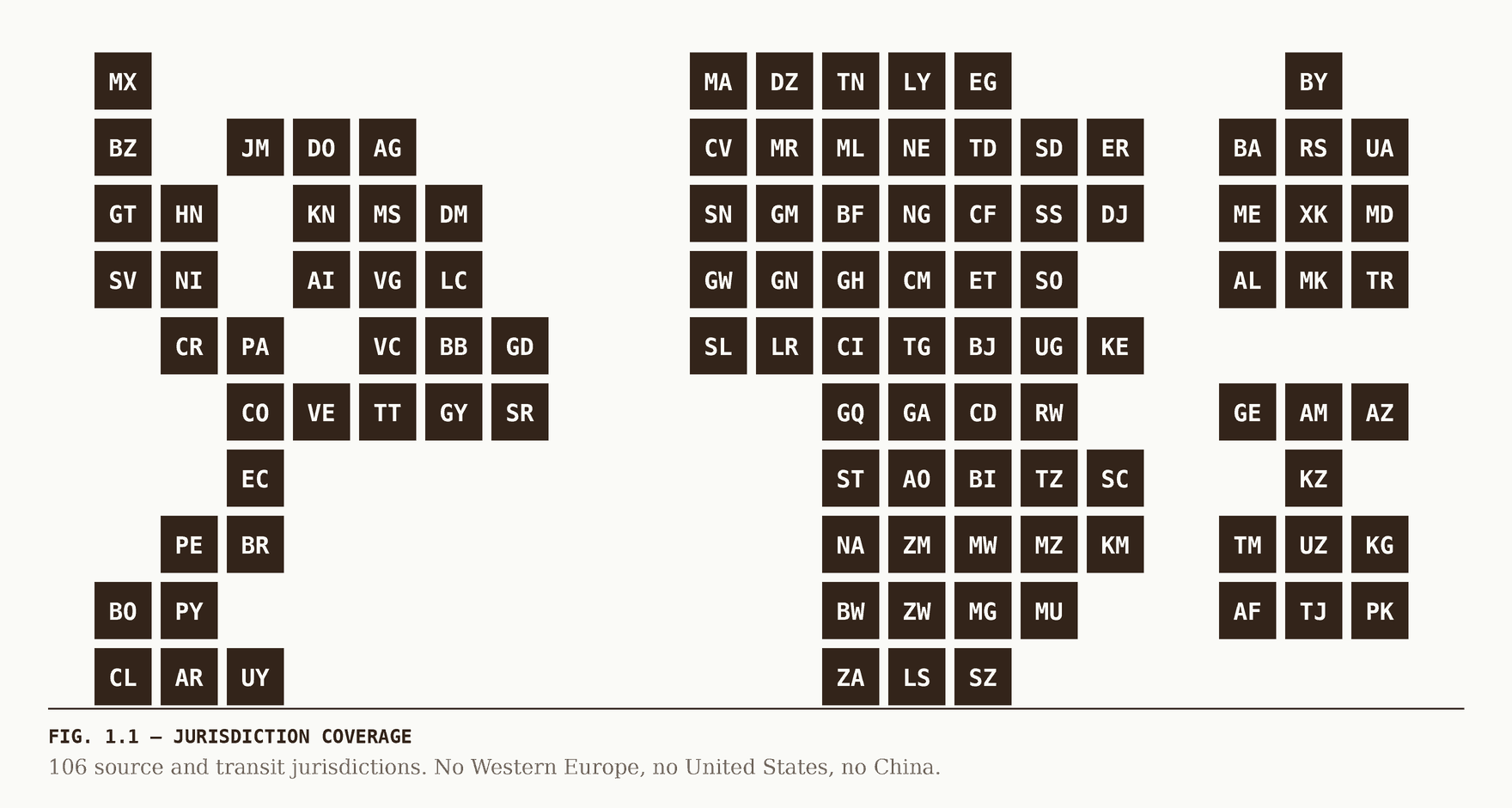
For a record system the relevant map is therefore not a route but a ratification. A jurisdiction bound by the Firearms Protocol has undertaken to mark weapons at manufacture and import and to keep the records for at least ten years; one that is not has no such obligation, and a weapon passing through it can lose its history legitimately. Of the 106 jurisdictions covered on this site, 83 are parties and 23 are not.
Not parties to the Firearms Protocol — 23
Afghanistan · Belize · Botswana · Cameroon · Chad · Colombia · Djibouti · Egypt · Equatorial Guinea · Eritrea · Gambia · Georgia · Guinea · Kosovo · Kyrgyzstan · Namibia · Niger · Pakistan · Saint Lucia · Suriname · Tajikistan · Uzbekistan · Zimbabwe
That list is the practical limit on what a shared tracing system can reconstruct. The system itself is neutral about it: it will return whatever was entered, and where no obligation to enter anything exists, an accurate query returns nothing and the absence looks identical to a clean history.
Treaty basis
In substance the work operationalises no instrument in this dataset covers environmental crime directly, which is the gap it operates in — the applicable obligations arrive through UNTOC where the conduct is organised and through the laundering provisions where the proceeds move. The distinction matters: a programme of this kind creates no legal powers of its own. It builds the capacity of states to use powers they already hold under instruments they have ratified, which is why a jurisdiction that is not party to the relevant instrument gains less from participation than one that is. What each instrument obliges is set out on the conventions reference.
Questions
What was ECO-SOLVE?
Innovative solutions against environmental crime, led by European Union. Environmental crime treated as a data problem: the trade is largely online, and what is missing is the means to read it at scale. The description on this page is drawn from European Commission, Service for Foreign Policy Instruments, which documents it.
What problem was ECO-SOLVE designed to address?
Environmental crime enters this subject through the same door as everything else on it. The official description is direct about why it belongs here at all: it is a major contributor to the growth of serious criminal activity and provides a soft entry point into global illicit flows for traffickers — a lower-risk, lower-penalty route into the same corridors, intermediaries and documents that carry narcotics and weapons. What distinguishes it operationally is where the trade happens. A great deal of it is conducted openly online, which makes it observable in a way a container is not, and unobserved in practice because nobody was reading the listings.
Which trafficking corridors does ECO-SOLVE relate to?
ECO-SOLVE is not organised around a geographic corridor. It is infrastructure that any jurisdiction can draw on, which is why it appears on the firearms page rather than on a route.
What is the treaty basis for this kind of work?
In substance, no instrument in this dataset covers environmental crime directly, which is the gap it operates in — the applicable obligations arrive through UNTOC where the conduct is organised and through the laundering provisions where the proceeds move. A programme of this kind does not create legal powers; it builds the capacity to use powers a state already has under instruments it has ratified, which is why the ratification position on each jurisdiction record matters to what such a programme can achieve there.
Is ECO-SOLVE still running?
This index does not assert a current operational state for any programme in it. Funding cycles turn over faster than the pages describing them, and a dossier that claimed a programme was active would be making a claim it could not keep current. European Commission, Service for Foreign Policy Instruments is the place to check, and it is linked from the sources at the foot of this page.
Why does ECO-SOLVE carry no corridor?
Because it is not organised around one. Its subject is the programme family rather than a route, so the geographic entry point is the 106-jurisdiction index rather than a corridor profile. The dossiers that do address corridors are listed on the programme index.
Sources
- European Commission, Service for Foreign Policy Instruments — Innovative solutions against environmental crime . Checked 2026-07-30.