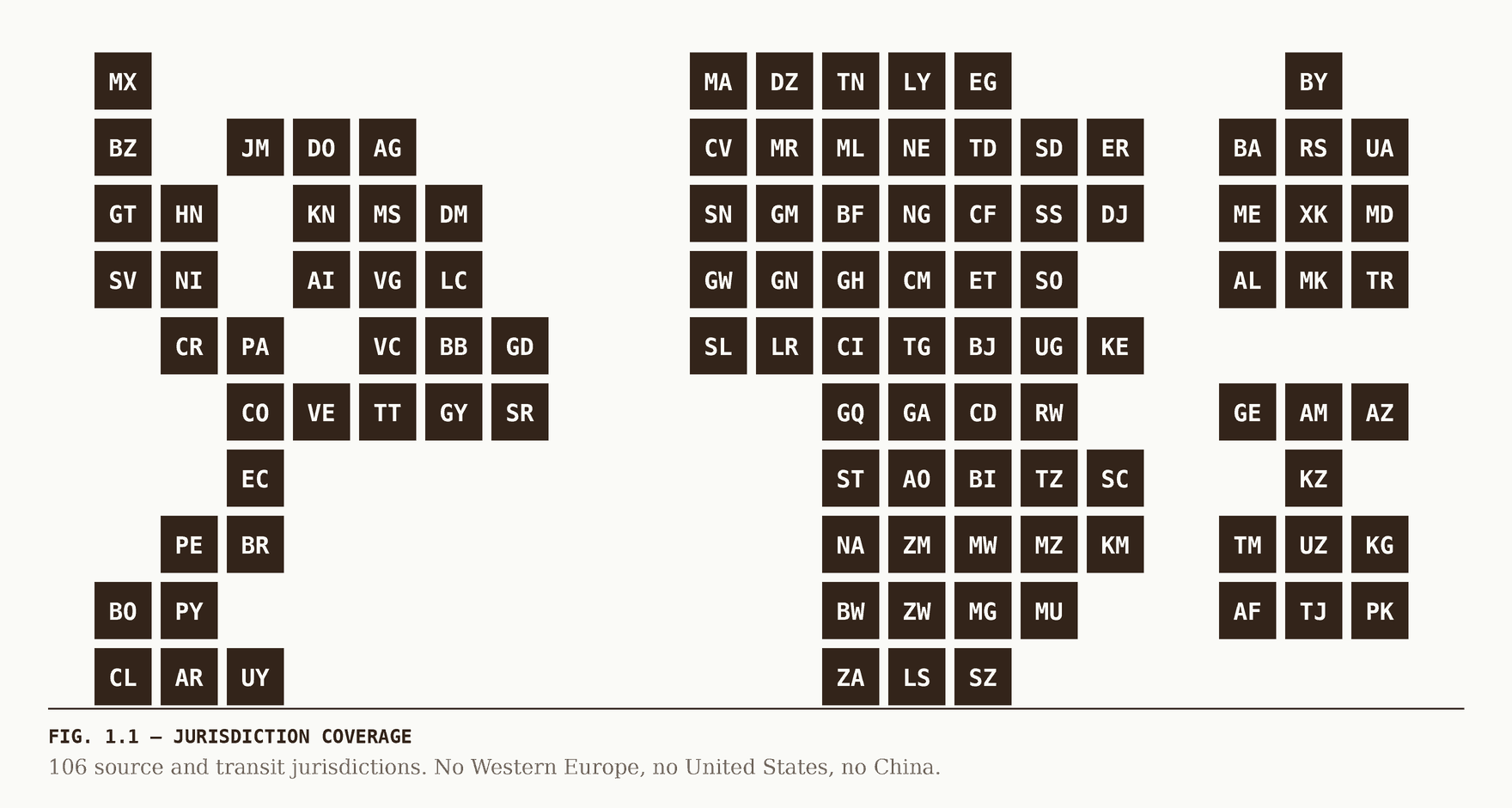
Fig. 1.1
Jurisdiction coverage
106 records. Sources named per field. Compiled 2026-07-29.
Drug laws by country: international penalties and legislation compared
This is a reference to drug laws by country across 106 source and transit jurisdictions — the states and territories that sit on the corridors carrying narcotics, firearms and the proceeds of both. Each record separates two things that are routinely conflated: what a state has signed internationally, and what its own statute book actually makes an offence. The first is a matter of record at the treaty depositary. The second is national drug legislation, and it varies far more than the treaty position suggests. Read together, the records let national drug legislation be compared across regions without treating an international commitment as evidence that a domestic offence exists.
Hatching
Section 02
How the instruments stack
How international drug control law reaches national statute
Four United Nations instruments sit above the national statutes in this dataset. The 1988 Convention against Illicit Traffic in Narcotic Drugs and Psychotropic Substances obliges parties to criminalise trafficking, cultivation for trafficking and the laundering of its proceeds, and supplies the legal basis for controlled delivery. The 2000 Convention against Transnational Organized Crime adds the organisational offences — participation in an organised criminal group, obstruction of justice — and the mutual legal assistance machinery. Its Firearms Protocol carries the marking, record-keeping and licensing requirements for small arms. The Convention against Corruption reaches the official conduct that lets the other three fail in practice.
None of the four is self-executing. A state that ratifies undertakes to legislate, and until it does there is no offence for a prosecutor to charge. This is the point at which an international obligation and a domestic offence part company, and it is why drug laws by country cannot be read off a ratification table. Each record here therefore names the national instrument separately, with the register it was confirmed against, rather than treating the treaty position as a proxy for domestic law.
Section 03
Reading the penalties
Penalties: what the national statutes prescribe
Penalties in these statutes are built from a small number of moving parts, and they are the reason a table of maximum sentences would mislead. Most instruments classify controlled substances into schedules and attach a penalty range to the schedule rather than to the substance. Most distinguish possession for personal use from possession for supply, and set the dividing line either by a stated quantity threshold or by leaving it to the court to infer purpose. Several attach the heaviest range not to the substance at all but to the circumstances — trafficking across a border, involving a minor, or acting as part of a group.
Two consequences follow. A single maximum sentence for a jurisdiction tells the reader very little without the classification and the threshold that trigger it. And a statute that has not been amended since the schedules were first drawn may not cover substances that have since appeared. Each record therefore states the instrument, its year, and the classifying mechanism it uses, and leaves the sentencing arithmetic to the text of the statute it cites. It is also why penalties are described here rather than reduced to a single column: a maximum sentence compared across jurisdictions, stripped of the classification and the threshold that trigger it, is a number without a meaning.
Table 2.1
Convention coverage
Convention coverage compared across 106 jurisdictions
Compared across the whole set, the treaty position is close to uniform: 81 of the 106 jurisdictions are party to all four instruments, and almost all of the remainder are party to three. The near-universal figure is itself the finding. Ratification is not where jurisdictions differ, so a reader looking for difference has to look at the national instrument, its age, and whether an enforcement authority is actually named in it — which is what the per-jurisdiction records carry and what the source tier below describes.
The Firearms Protocol is the usual exception. It is the least widely ratified of the four, and a state party to the other three without it will typically have narcotics legislation and no equivalent marking or tracing regime for small arms.
| Instrument | Adopted | Parties in this dataset |
|---|---|---|
| 1988 Convention United Nations Convention against Illicit Traffic in Narcotic Drugs and Psychotropic Substances | 1988 | 103 of 106 |
| UNTOC United Nations Convention against Transnational Organized Crime | 2000 | 105 of 106 |
| UNCAC United Nations Convention against Corruption | 2003 | 103 of 106 |
| Firearms Protocol Protocol against the Illicit Manufacturing of and Trafficking in Firearms, Their Parts and Components and Ammunition | 2001 | 83 of 106 |
Section 04
Source tiers
Where each record comes from
The source path is recorded per jurisdiction because it determines what a record of drug laws by country can honestly claim. Tier A means the national instrument was confirmed against an official register — a government law portal, a parliamentary repository, a gazette, or the United Nations Office on Drugs and Crime legal library, which reproduces the instruments themselves. Tier B means the treaty record is confirmed at the depositary but no national instrument could be verified against a citable source, and the record says so rather than naming an unverified statute.
Tier C covers the 4 dependent territories in the set. These are not treaty parties in their own right: the metropolitan state's ratification is extended to them, which is the real legal position and a more accurate record than reporting them as having ratified nothing.
Table 2.2
Jurisdiction index
106 records, grouped by region.
Drug laws by country: the full jurisdiction index
Every jurisdiction in the dataset, with its monitoring status, treaty count and source tier. Each name links to the full record.
Africa — 53
| Jurisdiction | FATF status | Conventions | Tier |
|---|---|---|---|
| Algeria | Not listed | 4 of 4 | A |
| Angola | Increased monitoring | 4 of 4 | A |
| Benin | Not listed | 4 of 4 | A |
| Botswana | Not listed | 3 of 4 | A |
| Burkina Faso | Not listed | 4 of 4 | B |
| Burundi | Not listed | 4 of 4 | A |
| Cabo Verde | Not listed | 4 of 4 | A |
| Cameroon | Increased monitoring | 3 of 4 | A |
| Central African Republic | Not listed | 4 of 4 | A |
| Chad | Not listed | 3 of 4 | A |
| Comoros | Not listed | 4 of 4 | B |
| Côte d'Ivoire | Increased monitoring | 4 of 4 | A |
| Democratic Republic of the Congo | Increased monitoring | 4 of 4 | B |
| Djibouti | Not listed | 3 of 4 | A |
| Egypt | Not listed | 3 of 4 | A |
| Equatorial Guinea | Not listed | 2 of 4 | A |
| Eritrea | Not listed | 2 of 4 | A |
| Eswatini | Not listed | 4 of 4 | A |
| Ethiopia | Not listed | 4 of 4 | A |
| Gabon | Not listed | 4 of 4 | A |
| Gambia | Not listed | 3 of 4 | A |
| Ghana | Not listed | 4 of 4 | A |
| Guinea | Not listed | 3 of 4 | A |
| Guinea Bissau | Not listed | 4 of 4 | A |
| Kenya | Increased monitoring | 4 of 4 | A |
| Lesotho | Not listed | 4 of 4 | A |
| Liberia | Not listed | 4 of 4 | B |
| Libya | Not listed | 4 of 4 | B |
| Madagascar | Not listed | 4 of 4 | A |
| Malawi | Not listed | 4 of 4 | B |
| Mali | Not listed | 4 of 4 | A |
| Mauritania | Not listed | 4 of 4 | A |
| Mauritius | Not listed | 4 of 4 | A |
| Morocco | Not listed | 4 of 4 | A |
| Mozambique | Not listed | 4 of 4 | B |
| Namibia | Not listed | 3 of 4 | A |
| Niger | Not listed | 3 of 4 | A |
| Nigeria | Not listed | 4 of 4 | A |
| Rwanda | Not listed | 4 of 4 | A |
| Sao Tome and Principe | Not listed | 4 of 4 | B |
| Senegal | Not listed | 4 of 4 | A |
| Seychelles | Not listed | 4 of 4 | A |
| Sierra Leone | Not listed | 4 of 4 | A |
| Somalia | Not listed | 3 of 4 | B |
| South Africa | Not listed | 4 of 4 | A |
| South Sudan | Increased monitoring | 4 of 4 | B |
| Sudan | Not listed | 4 of 4 | A |
| Tanzania | Not listed | 4 of 4 | A |
| Togo | Not listed | 4 of 4 | A |
| Tunisia | Not listed | 4 of 4 | A |
| Uganda | Not listed | 4 of 4 | A |
| Zambia | Not listed | 4 of 4 | A |
| Zimbabwe | Not listed | 3 of 4 | A |
Latin America and the Caribbean — 33
| Jurisdiction | FATF status | Conventions | Tier |
|---|---|---|---|
| Anguilla | Not listed | 4 of 4 | C |
| Antigua and Barbuda | Not listed | 4 of 4 | A |
| Argentina | Not listed | 4 of 4 | A |
| Barbados | Not listed | 4 of 4 | A |
| Belize | Not listed | 3 of 4 | A |
| Bolivia | Increased monitoring | 4 of 4 | A |
| Brazil | Not listed | 4 of 4 | A |
| British Virgin Islands | Increased monitoring | 4 of 4 | C |
| Chile | Not listed | 4 of 4 | A |
| Colombia | Not listed | 3 of 4 | A |
| Costa Rica | Not listed | 4 of 4 | A |
| Dominica | Not listed | 4 of 4 | A |
| Dominican Republic | Not listed | 4 of 4 | A |
| Ecuador | Not listed | 4 of 4 | A |
| El Salvador | Not listed | 4 of 4 | A |
| Grenada | Not listed | 4 of 4 | A |
| Guatemala | Not listed | 4 of 4 | A |
| Guyana | Not listed | 4 of 4 | A |
| Honduras | Not listed | 4 of 4 | A |
| Jamaica | Not listed | 4 of 4 | A |
| Mexico | Not listed | 4 of 4 | A |
| Montserrat | Not listed | 4 of 4 | C |
| Nicaragua | Not listed | 4 of 4 | A |
| Panama | Not listed | 4 of 4 | A |
| Paraguay | Not listed | 4 of 4 | A |
| Peru | Not listed | 4 of 4 | A |
| Saint Kitts and Nevis | Not listed | 4 of 4 | B |
| Saint Lucia | Not listed | 3 of 4 | A |
| Saint Vincent and the Grenadines | Not listed | 3 of 4 | A |
| Suriname | Not listed | 3 of 4 | B |
| Trinidad and Tobago | Not listed | 4 of 4 | A |
| Uruguay | Not listed | 4 of 4 | A |
| Venezuela | Increased monitoring | 4 of 4 | A |
Central Asia — 10
| Jurisdiction | FATF status | Conventions | Tier |
|---|---|---|---|
| Afghanistan | Not listed | 3 of 4 | A |
| Armenia | Not listed | 4 of 4 | A |
| Azerbaijan | Not listed | 4 of 4 | A |
| Georgia | Not listed | 3 of 4 | A |
| Kazakhstan | Not listed | 4 of 4 | A |
| Kyrgyzstan | Not listed | 3 of 4 | B |
| Pakistan | Not listed | 3 of 4 | A |
| Tajikistan | Not listed | 3 of 4 | A |
| Turkmenistan | Not listed | 4 of 4 | B |
| Uzbekistan | Not listed | 3 of 4 | A |
Balkans and eastern Europe — 10
| Jurisdiction | FATF status | Conventions | Tier |
|---|---|---|---|
| Albania | Not listed | 4 of 4 | A |
| Belarus | Not listed | 4 of 4 | A |
| Bosnia and Herzegovina | Increased monitoring | 4 of 4 | A |
| Kosovo | Not listed | 0 of 4 | C |
| Moldova | Not listed | 4 of 4 | A |
| Montenegro | Not listed | 4 of 4 | A |
| North Macedonia | Not listed | 4 of 4 | A |
| Serbia | Not listed | 4 of 4 | A |
| Türkiye | Not listed | 4 of 4 | A |
| Ukraine | Not listed | 4 of 4 | A |
Section 05
Questions
Questions about this dataset
What does this dataset record for each jurisdiction?
Each record carries the national narcotics and firearms instruments that could be confirmed against an official register, the four United Nations instruments the state is party to with the exact date the depositary recorded, the jurisdiction's current standing in the Financial Action Task Force monitoring process, and the enforcement authority named in that legislation. Where a field could not be confirmed against a citable source it is reported as not recorded rather than filled with an estimate.
Why are these 106 jurisdictions covered and not every country?
The set is source and transit jurisdictions along the corridors that carry narcotics, firearms and the proceeds of both: Africa, Latin America and the Caribbean, Central Asia and its approaches, and the Balkans and eastern Europe. Consumer markets in western Europe, North America and east Asia are not included, so this is not a world index and the cartogram is not a world map.
Does ratifying a convention mean the offences exist in national law?
No, and the gap between the two is the most common misreading of this data. Ratification binds a state to legislate; it does not itself create an offence a prosecutor can charge. A state can be party to all four instruments while its implementing statute is decades old, narrower than the convention, or absent for one category entirely. That is why the national instrument is recorded separately from the treaty record.
Why do some records name a statute and others do not?
Because the source path differs, and it is reported rather than smoothed over. Tier A means the instrument itself was confirmed against an official register. Tier B means the treaty record is confirmed but no national instrument could be verified against a citable source. Tier C covers dependent territories, where the metropolitan state's ratification is extended to the territory rather than the territory acceding in its own right.
What does FATF increased monitoring actually mean for a jurisdiction?
It means the Financial Action Task Force has identified strategic deficiencies in that jurisdiction's controls against money laundering and terrorist financing, and the jurisdiction has agreed an action plan and timeline to address them. It is a process status, not a finding that a state is uncooperative, and it changes: the plenary reviews the list three times a year, so 10 of the 106 jurisdictions here are listed as of the last review rather than permanently.