Africa
Source tier A. Conventions checked 2026-07-29.
Drug and firearms law in Equatorial Guinea: statutes on record
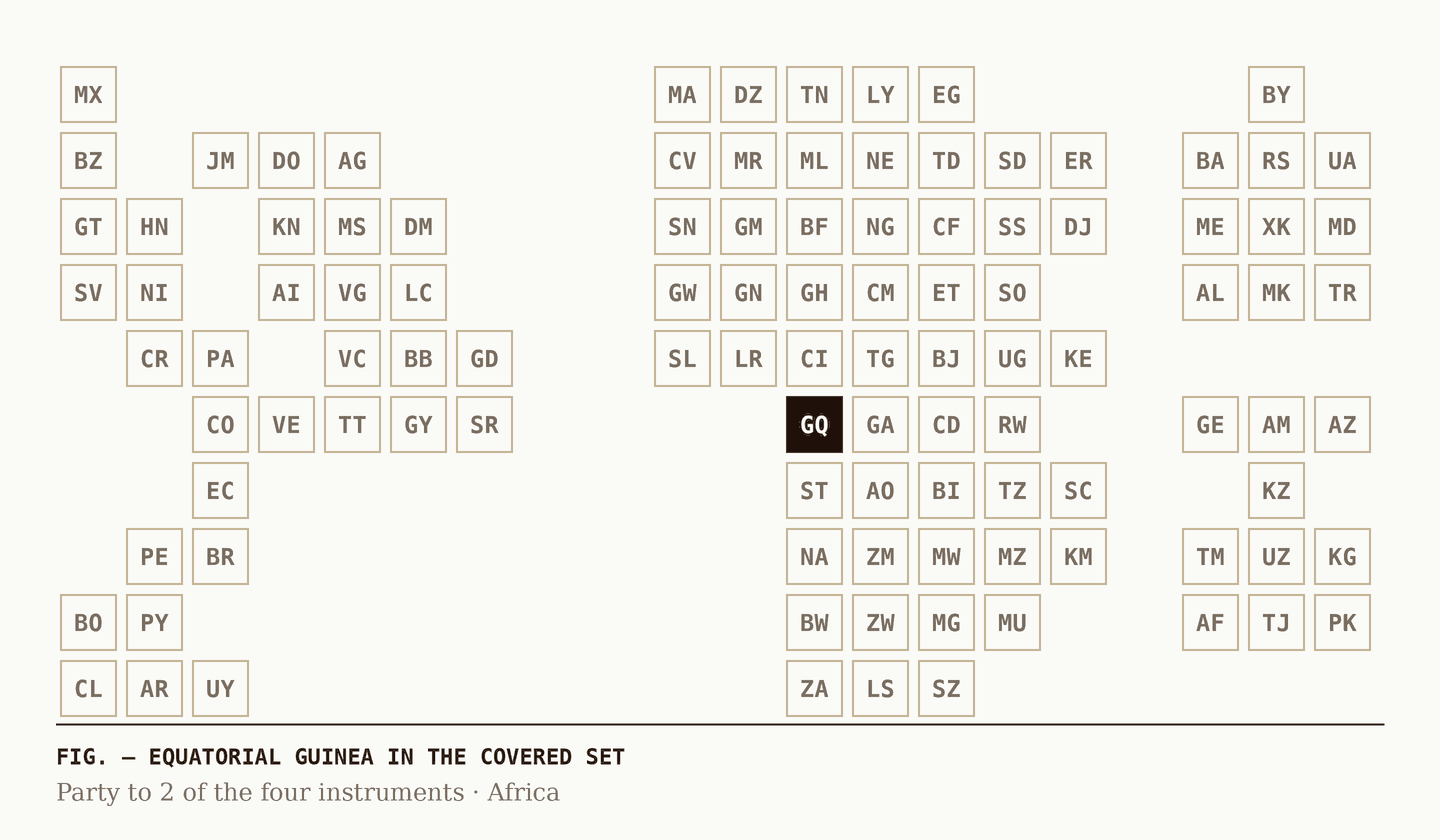
Equatorial Guinea, in Africa, is party to 2 of the four instruments tracked here but not to the 1988 Convention or the Firearms Protocol. It appears on neither FATF list. Its confirmed instrument on record is the Dec Law 3 of 1993. Nothing below is asserted without the document it came from being named alongside it.
International framework
Equatorial Guinea is bound by 2 of the four instruments this dataset tracks, the earliest from 2003 and the most recent from 2018. It is not a party to the 1988 Convention or the Firearms Protocol.
| Instrument | Adopted | Ratified or acceded | Depositary reference |
|---|---|---|---|
| 1988 Convention | 1988 | not a party | Chapter VI-19 |
| UNTOC | 2000 | 7 Feb 2003 | Chapter XVIII-12 |
| UNCAC | 2003 | 30 May 2018 | Chapter XVIII-14 |
| Firearms Protocol | 2001 | not a party | Chapter XVIII-12-c |
What each instrument obliges a party to do is set out once, per instrument, in the conventions reference. The dates above are what is specific to Equatorial Guinea: they are the points from which each obligation began to bind, taken from the depositary's own status tables.
National legislation
Below are the confirmed instruments, given in their enacted titles. Where a register supplies a citation number it is carried through unchanged.
Dec Law 3 (1993) — A principal instrument in its own right, confirmed on the register named below; its subject matter is not stated on the face of its title. Confirmed against the UNODC legal library, checked 2026-07-30.
Enforcement authorities
No enforcement body is named in this record for Equatorial Guinea. The bodies that would appear
here are those identified on the jurisdiction's own government hosts — the police service,
customs administration, prosecuting authority or dedicated drug agency, reachable under the .gq country-code domain. No citable naming was located. The institutions almost certainly exist; what is missing is an official page that identifies them, which is the only thing this field records.
Ratification sequence
How a state assembled its treaty position is itself a fact about the position. Equatorial Guinea came to these instruments over 15 years, beginning with the UNTOC in 2003 and ending with the UNCAC in 2018. Measured against each instrument's own adoption, the shortest gap was the UNTOC at 3 years, the longest the UNCAC at 15.
Equatorial Guinea became a party to the UNTOC in 2003, 3 years after it was adopted — faster than the median lag of 4 years across this dataset.
What sat in the gaps between them is the less obvious half of the record. For the 15 years between 2003 and 2018, Equatorial Guinea was bound by the UNTOC but not yet by the UNCAC. Nothing in the later instruments reaches back into that window, which is why a complete position today says little about a case from then.
On coverage, Equatorial Guinea is one of 2 jurisdiction s here party to 2 of the four, against 81 party to all four. Within Africa the dataset holds 53 jurisdictions, of which 6 are currently under FATF increased monitoring.
What is not in force
2 of the four instruments do not bind Equatorial Guinea. Each gap removes something particular.
1988 Convention — adopted 1988, and Equatorial Guinea is not a party. In practice, the state has not taken on the core drug-trafficking obligations, which in practice also removes the treaty basis for controlled delivery and for confiscation cooperation.
Firearms Protocol — adopted 2001, and Equatorial Guinea is not a party. In practice, there is no treaty obligation to mark or trace weapons, so a firearm recovered at a crime scene may have no route back to its point of diversion — the single most common reason a trafficking chain cannot be reconstructed.
Financial-crime monitoring
As of the FATF plenary statements of 2026-06-19, Equatorial Guinea is recorded as Not listed . Absence from both lists is not a clean bill of health: it means no strategic deficiency has been identified, which is not the same as none existing. How the plenary reaches these decisions is covered on the FATF grey list tracker.
Questions about drug and firearms law in Equatorial Guinea
Which drug-control conventions has Equatorial Guinea ratified?
2 of the four instruments tracked here — the UNTOC (7 Feb 2003), the UNCAC (30 May 2018). It is not a party to the 1988 Convention or the Firearms Protocol.
Is Equatorial Guinea on the FATF grey list?
No. Equatorial Guinea appears on neither the increased-monitoring list nor the call-for-action list in the FATF statements of 19 June 2026.
What national drug legislation is on record for Equatorial Guinea?
Dec Law 3, confirmed against the UNODC legal library.
Which register confirms the legislation on this page?
Each instrument names its own. For Equatorial Guinea that is the UNODC legal library. Following the link reaches the document itself; nothing here paraphrases an instrument it has not cited.
What is source tier A, and why is this record in it?
Tier A means a national instrument has been confirmed against an official register — for Equatorial Guinea, 1 of them. The treaty dates and the listing status are separately sourced, so all three layers of this record carry a citation.
What does it mean that Equatorial Guinea is not a party to the 1988 Convention?
In practice, the state has not taken on the core drug-trafficking obligations, which in practice also removes the treaty basis for controlled delivery and for confiscation cooperation.
Sources
- Ratification dates: United Nations Treaty Collection, depositary status tables (chapters VI-19, XVIII-12, XVIII-14, XVIII-12-c). Checked 2026-07-29.
- Listing status: FATF, Jurisdictions under Increased Monitoring and High-Risk Jurisdictions subject to a Call for Action, 2026-06-19.
- Dec Law 3: the UNODC legal library, checked 2026-07-30.