Table 3.1
Listing status
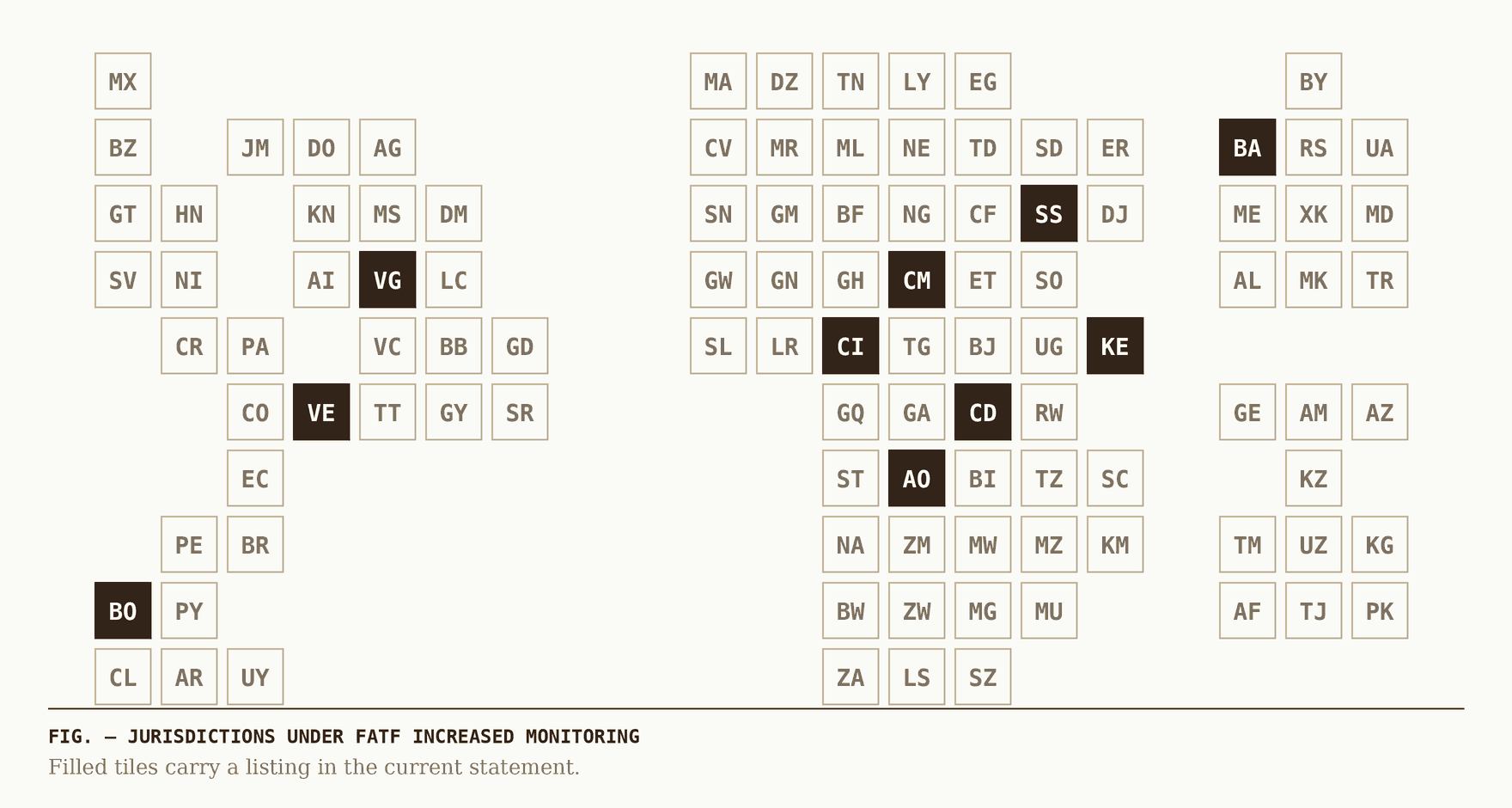
22 monitored · 3 call for action. Statement of 19 June 2026.
FATF grey list and blacklist: the countries under increased monitoring
The FATF grey list is the working name for the Financial Action Task Force's list of jurisdictions under increased monitoring. As of the statement of 19 June 2026 the FATF grey list countries number 22, and they are not a fixed set: the plenary revises them three times a year, so any count is dated rather than permanent. A listing means the jurisdiction has been found to have strategic deficiencies in its controls against money laundering and terrorist financing, and has agreed a plan and a timetable to address them. A separate and much shorter list — the one usually called the blacklist — names 3.
Section 01
The list
Which countries are on the FATF grey list
The FATF grey list countries in full, as the statement records them, are the jurisdictions under increased monitoring set out below. 10 of the 22 are source or transit jurisdictions covered by this site and link to their own record; the others are named because the list names them, but they fall outside the coverage described on the jurisdiction index.
| Jurisdiction | Record on this site |
|---|---|
| Angola | Full record |
| Bolivia | Full record |
| Bosnia and Herzegovina | Full record |
| Bulgaria | not covered |
| Cameroon | Full record |
| Côte d'Ivoire | Full record |
| Democratic Republic of the Congo | Full record |
| Haiti | not covered |
| Iraq | not covered |
| Kenya | Full record |
| Kuwait | not covered |
| Lao PDR | not covered |
| Lebanon | not covered |
| Monaco | not covered |
| Nepal | not covered |
| Papua New Guinea | not covered |
| South Sudan | Full record |
| Syria | not covered |
| Venezuela | Full record |
| Vietnam | not covered |
| Virgin Islands (UK) | Full record |
| Yemen | not covered |
Section 02
Call for action
The blacklist: jurisdictions subject to a call for action
The call-for-action list is the more serious of the two and is far shorter. It currently names Democratic People's Republic of Korea (DPRK), Iran, Myanmar. Where the grey list is a supervisory process, this list asks other members to apply enhanced due diligence to business involving the jurisdiction, and in the most serious case to apply counter-measures — a direct instruction to the financial system rather than a programme of reform.
The distinction matters when reading secondary sources, which frequently merge the two into a single "FATF blacklist" of twenty-odd countries. They are separate statements, published on the same day, with different legal consequences for a bank deciding whether to process a payment.
Section 03
What the plenary decided
What changed at the latest plenary
The FATF reviewed progress since February 2026 for Algeria, Angola, Bolivia, Bulgaria, Cameroon, Côte d'Ivoire, the Democratic Republic of the Congo, Haiti, Kenya, Lao PDR, Lebanon, Monaco, Namibia, Nepal, South Sudan, Syria, Venezuela, Vietnam, the Virgin Islands (UK) and Yemen. Algeria and Namibia were removed from increased monitoring. Kuwait and Papua New Guinea chose to defer reporting, so their earlier statements stand.
| Decision | Jurisdictions |
|---|---|
| Removed from monitoring | Algeria, Namibia |
| Newly listed | none |
| Deferred reporting | Kuwait, Papua New Guinea |
A jurisdiction that defers reporting is not removed and is not newly criticised: its previous statement simply stands until the next plenary. Reading a deferral as a change is the second common error in summaries of these documents.
Section 04
Reading the status
What increased monitoring means in practice
Increased monitoring is a status in a process, not a verdict on a country. A jurisdiction enters it after a mutual evaluation identifies strategic deficiencies — typically in beneficial-ownership transparency, supervision of non-financial businesses, or the capacity to investigate and prosecute laundering rather than only the predicate offence. It then works to an action plan with deadlines, and reports at each plenary.
The practical effect is felt through correspondent banking. Institutions elsewhere apply enhanced due diligence to counterparties in a listed jurisdiction, which raises the cost and slows the speed of legitimate payments as well as illegitimate ones. That cost is the pressure the process relies on, and it is also why delisting is pursued so actively.
For the jurisdictions in this dataset the status is recorded on each country record alongside its treaty position and its national legislation, because the three answer different questions: whether the state is bound, what its own law says, and how well the system that enforces it is currently judged to work.
Section 05
Questions
Questions about the listing process
What is the difference between the FATF grey list and the blacklist?
They are different findings with different consequences. Increased monitoring — the grey list — means a jurisdiction has strategic deficiencies in its controls and has agreed an action plan with the FATF to fix them within an agreed timeframe; it remains a cooperating member of the process. The call-for-action list, commonly called the blacklist, names 3 jurisdictions and asks other countries to apply enhanced due diligence, and in the most serious case counter-measures. The first is supervision, the second is a warning to the financial system.
How many countries are on the FATF grey list?
22, as of the statement of 19 June 2026. 10 of them are source or transit jurisdictions covered by this site and carry a full record; the remainder are listed here but have no separate page. The number moves at each plenary, in both directions.
How often does the list change?
Three times a year. The FATF plenary meets in February, June and October, and each meeting can add jurisdictions, remove them, or leave a statement standing where a jurisdiction has deferred reporting. That cadence is why no date-stamped monthly claim appears on this page: between plenaries, nothing changes.
Does being on the grey list mean a country is uncooperative?
No, and the inference is the usual misreading. A jurisdiction is on the list precisely because it has committed to an action plan and is reporting against it. Removal follows an on-site assessment confirming the reforms are in place and being sustained, which is why a delisting is a more substantive signal than a listing.
What happened to Algeria and Namibia?
Both were removed from increased monitoring at the plenary of 19 June 2026. They still appear as headings on the FATF's June statement, under its "Jurisdictions No Longer subject to Increased Monitoring" section — reading the headings alone inverts their status, which is a common error in secondary summaries of that document.
Sources
- FATF, Jurisdictions under Increased Monitoring, 19 June 2026. Checked 2026-07-29.
- FATF, High-Risk Jurisdictions subject to a Call for Action, 19 June 2026. Checked 2026-07-29.
Next plenary: 2026-10. This page is rebuilt on the plenary cycle.