Africa
Source tier A. Conventions checked 2026-07-29.
Drug and firearms law in Kenya: statutes on record and in force
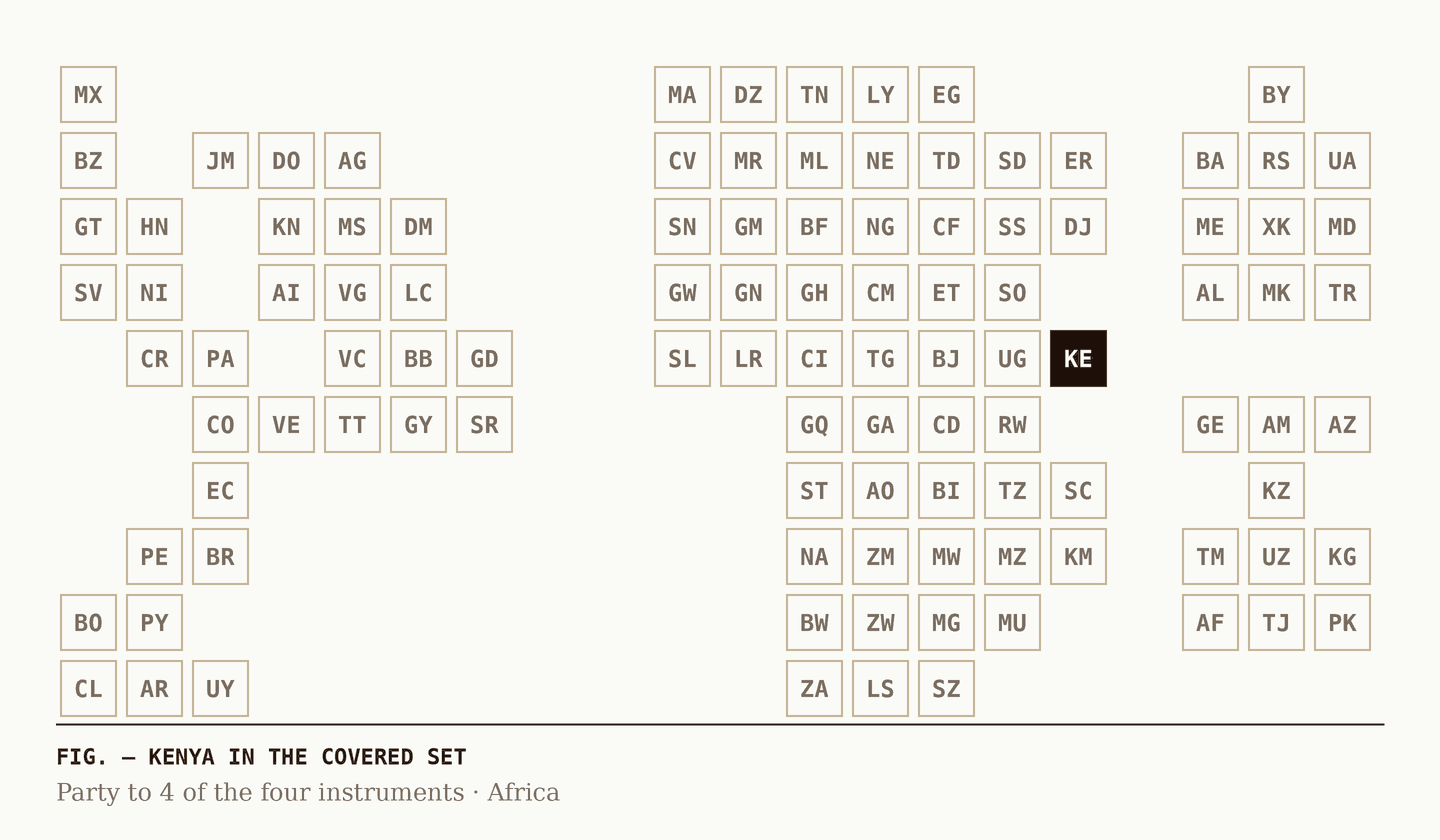
Kenya, in Africa, is party to all four of the instruments tracked here, the last of them since 2005. It is currently under increased monitoring by the FATF. Its legislation on record runs to 5 confirmed instruments, the earliest from 1956. The record is set out in the order the obligations arrive: treaty first, statute second, enforcement last.
International framework
Kenya is bound by all four instruments this dataset tracks, the earliest from 1992 and the most recent from 2005.
| Instrument | Adopted | Ratified or acceded | Depositary reference |
|---|---|---|---|
| 1988 Convention | 1988 | 19 Oct 1992 | Chapter VI-19 |
| UNTOC | 2000 | 16 Jun 2004 | Chapter XVIII-12 |
| UNCAC | 2003 | 9 Dec 2003 | Chapter XVIII-14 |
| Firearms Protocol | 2001 | 5 Jan 2005 | Chapter XVIII-12-c |
What each instrument obliges a party to do is set out once, per instrument, in the conventions reference. The dates above are what is specific to Kenya: they are the points from which each obligation began to bind, taken from the depositary's own status tables.
National legislation
These are the instruments an official source confirms for Kenya. The list is what could be cited, not necessarily everything in force.
Narcotic Drugs and Psychotropic Substances (Control) Act (Act No. 4 of 1994, 1994) — Kenya's principal drug-control statute. It sets the offences for trafficking, possession and cultivation, provides for the forfeiture of proceeds and the property used in an offence, and is the instrument through which the 1988 Convention obligations are carried into domestic law. Confirmed against Kenya Law, checked 2026-07-29.
Pharmacy and Poisons Act (Cap. 244, 1956) — Governs the licensing and handling of scheduled substances, which is the control layer that sits underneath the trafficking offences — the route by which a precursor or a medicine becomes a regulated rather than a prohibited item. Confirmed against Kenya Law, checked 2026-07-29.
The Narcotic Drugs And Psychotropic Substances (Control) Act, 1994 — A principal drug control instrument, carrying the 1988 Convention's trafficking and confiscation obligations into domestic law. Confirmed against Kenya Law, checked 2026-07-30.
Legal Notice No.150 the Pharmacy and Poisons Act — A subordinate instrument, made under the authority of a parent act rather than standing alone — typically the schedules, thresholds and licensing detail. Confirmed against the Parliament of Kenya, checked 2026-07-30.
Legal Notice No.151 the Dangerous Drugs Act — A subsidiary instrument under the drug control legislation: the schedules, licensing and procedural detail that the parent act leaves to be made by regulation. Confirmed against the Parliament of Kenya library, checked 2026-07-30.
Enforcement authorities
One body is named in the record for Kenya, each confirmed on Kenya's own government domain. A named body is not the same as an operative one, but it establishes where the mandate sits — and a mandate no institution holds is the gap that treaty coverage cannot close.
| Body | Function | Confirmed on |
|---|---|---|
| National Police Service | criminal investigation | nationalpolice.go.ke |
Ratification sequence
The order matters as much as the count. Kenya came to these instruments over 13 years, beginning with the 1988 Convention in 1992 and ending with the Firearms Protocol in 2005. Measured against each instrument's own adoption, the shortest gap was the UNCAC at 0 years, the longest the 1988 Convention at 4.
Kenya became a party to the 1988 Convention in 1992, 4 years after it was adopted — faster than the median lag of 5 years across this dataset.
Between the first date and the last, the framework binding this jurisdiction was incomplete in specific ways. For the 11 years between 1992 and 2003, Kenya was bound by the 1988 Convention but not yet by the UNCAC, the UNTOC or the Firearms Protocol. A case opened in one of those years would have had a narrower framework available to it than the same case opened now.
On coverage, Kenya is one of 81 jurisdiction s here party to 4 of the four, against 81 party to all four. Of the 53 Africa jurisdictions in this dataset, 6 sit under increased monitoring at present.
Position on the trafficking corridors
Kenya sits on the southern route, one of the six corridors profiled here. The record above is what a consignment moving along it encounters here.
The southern route — 7 jurisdictions, carrying heroin. The legs either side of Kenya in the reporting are Somalia and Tanzania. Across the corridor as a whole, 5 of the 7 legs are party to all four instruments, 1 sit outside the Firearms Protocol, 2 carry no confirmed national instrument , and 1 is under increased monitoring. Kenya carries one of those gaps. The corridor profile carries the leg-by-leg comparison.
Financial-crime monitoring
As of the FATF plenary statements of 2026-06-19, Kenya is recorded as Increased monitoring . What that status means, and how it differs from the call-for-action list, is set out on the FATF grey list tracker.
Questions about drug and firearms law in Kenya
Which drug-control conventions has Kenya ratified?
All four: the 1988 Convention on 19 Oct 1992, the UNTOC on 16 Jun 2004, the UNCAC on 9 Dec 2003, the Firearms Protocol on 5 Jan 2005.
Is Kenya on the FATF grey list?
Yes. Kenya is under increased monitoring as of the FATF plenary statement of 19 June 2026. That means the FATF has identified strategic deficiencies in its anti-money-laundering and counter-terrorist-financing regime and the jurisdiction has committed to an action plan with review deadlines.
What national drug legislation is on record for Kenya?
Narcotic Drugs and Psychotropic Substances (Control) Act (Act No. 4 of 1994), confirmed against Kenya Law; Pharmacy and Poisons Act (Cap. 244), confirmed against Kenya Law; The Narcotic Drugs And Psychotropic Substances (Control) Act, 1994, confirmed against Kenya Law; Legal Notice No.150 the Pharmacy and Poisons Act, confirmed against the Parliament of Kenya; Legal Notice No.151 the Dangerous Drugs Act, confirmed against the Parliament of Kenya library.
Which register confirms the legislation on this page?
Each instrument names its own. For Kenya that is Kenya Law, the Parliament of Kenya, the Parliament of Kenya library. The citation is to the issuing register rather than to any account of it, so the text can be read as enacted.
What is source tier A, and why is this record in it?
Tier A means a national instrument has been confirmed against an official register — for Kenya, 5 of them. The treaty dates and the listing status are separately sourced, so all three layers of this record carry a citation.
Why does the ratification date matter?
The date is the point from which the obligations bind. Kenya's earliest of these commitments dates from 1992, its most recent from 2005; the gap between them is a rough measure of how long the framework took to assemble.
Sources
- Ratification dates: United Nations Treaty Collection, depositary status tables (chapters VI-19, XVIII-12, XVIII-14, XVIII-12-c). Checked 2026-07-29.
- Listing status: FATF, Jurisdictions under Increased Monitoring and High-Risk Jurisdictions subject to a Call for Action, 2026-06-19.
- Narcotic Drugs and Psychotropic Substances (Control) Act: Kenya Law, checked 2026-07-29.
- Pharmacy and Poisons Act: Kenya Law, checked 2026-07-29.
- The Narcotic Drugs And Psychotropic Substances (Control) Act, 1994: Kenya Law, checked 2026-07-30.
- Legal Notice No.150 the Pharmacy and Poisons Act: the Parliament of Kenya, checked 2026-07-30.
- Legal Notice No.151 the Dangerous Drugs Act: the Parliament of Kenya library, checked 2026-07-30.