Section 04
Illicit finance
Conventions reference for all 106 jurisdiction records.
Illicit financial flows: money laundering and beneficial ownership law
Illicit financial flows are the movements of value across borders that are illegally earned, illegally transferred or illegally used. The phrase covers three different things at once — the proceeds of crime, the proceeds of corruption, and commercial flows that evade tax or exchange controls — and most disagreement about the scale of illicit financial flows is really disagreement about which of the three is being counted. What follows separates the mechanisms from the legal framework that is supposed to address them.
Section 01
Mechanisms
How cross-border money laundering moves value
Cross-border money laundering is rarely the suitcase of cash of the popular account. The dominant channels are mundane and documentary. Value moves as mis-priced trade, where an invoice states a figure the goods do not justify and the difference settles abroad. It moves through cash-intensive intermediaries whose turnover cannot be reconciled against anything. It moves through layered corporate ownership, where each transfer is individually lawful and the chain as a whole has no economic purpose.
What these have in common is that no single step looks criminal. That is the design. An investigator who can see one transaction sees a normal one; the pattern only appears when the counterparties, the pricing and the ownership can be examined together, which is precisely what fragmented records prevent. Cross-border money laundering is therefore less a problem of detecting a suspicious transaction than of assembling records held in different jurisdictions under different disclosure rules. The largest single channel by value is examined separately in trade-based money laundering.
Section 02
Ownership
Beneficial ownership: who actually controls the counterparty
Beneficial ownership is the question of which natural person ultimately controls a company or benefits from it, as distinct from whose name appears on its registration. The two diverge routinely and legitimately, and the divergence is also the single most effective concealment available: a nominee director, a corporate shareholder registered elsewhere, or a trust arrangement will each stop a trace at the point where the record ends.
This is why beneficial ownership dominates the reform agenda. Of the deficiencies cited when a jurisdiction is placed under increased monitoring, incomplete or unverified ownership registries are among the most common, and building one is among the most frequently required actions before removal. 22 jurisdictions are currently in that process — the current list and what the last plenary decided are on the FATF grey list tracker.
Table 4.1
The four instruments
Ratification per jurisdiction is recorded on each country page.
The four conventions and what each obliges
Four United Nations instruments sit above the national statutes recorded across this site. Each country record states the dates on which they became binding for that jurisdiction; what they require is set out here, once, rather than repeated on every record.
1988 Convention
United Nations Convention against Illicit Traffic in Narcotic Drugs and Psychotropic Substances · adopted 1988 · chapter VI-19 · 103 of 106 jurisdictions here are parties
A party undertakes criminalising trafficking, cultivation and the laundering of drug proceeds; enabling the confiscation of proceeds and instrumentalities; and permitting controlled delivery, the technique of letting a consignment run under surveillance instead of seizing it at the border.
Where a state is not a party: the state has not taken on the core drug-trafficking obligations, which in practice also removes the treaty basis for controlled delivery and for confiscation cooperation.
UNTOC
United Nations Convention against Transnational Organized Crime · adopted 2000 · chapter XVIII-12 · 105 of 106 jurisdictions here are parties
A party undertakes criminalising participation in an organised criminal group, money laundering, corruption and obstruction of justice, and providing mutual legal assistance and extradition for those offences.
Where a state is not a party: organised-crime cooperation has to rest on bilateral arrangements rather than on a common framework, which slows mutual legal assistance considerably.
UNCAC
United Nations Convention against Corruption · adopted 2003 · chapter XVIII-14 · 103 of 106 jurisdictions here are parties
A party undertakes criminalising bribery, embezzlement and the laundering of proceeds of corruption, and providing for asset recovery — the return of stolen assets to the state of origin.
Where a state is not a party: the asset-recovery route is unavailable, which matters most where proceeds are moved abroad through a corrupt public official rather than by a trafficking network.
Firearms Protocol
Protocol against the Illicit Manufacturing of and Trafficking in Firearms, Their Parts and Components and Ammunition · adopted 2001 · chapter XVIII-12-c · 83 of 106 jurisdictions here are parties
A party undertakes criminalising illicit manufacturing and trafficking in firearms, marking weapons at manufacture and import so they can be traced, keeping records for at least ten years, and licensing or authorising every transfer.
Where a state is not a party: there is no treaty obligation to mark or trace weapons, so a firearm recovered at a crime scene may have no route back to its point of diversion — the single most common reason a trafficking chain cannot be reconstructed.
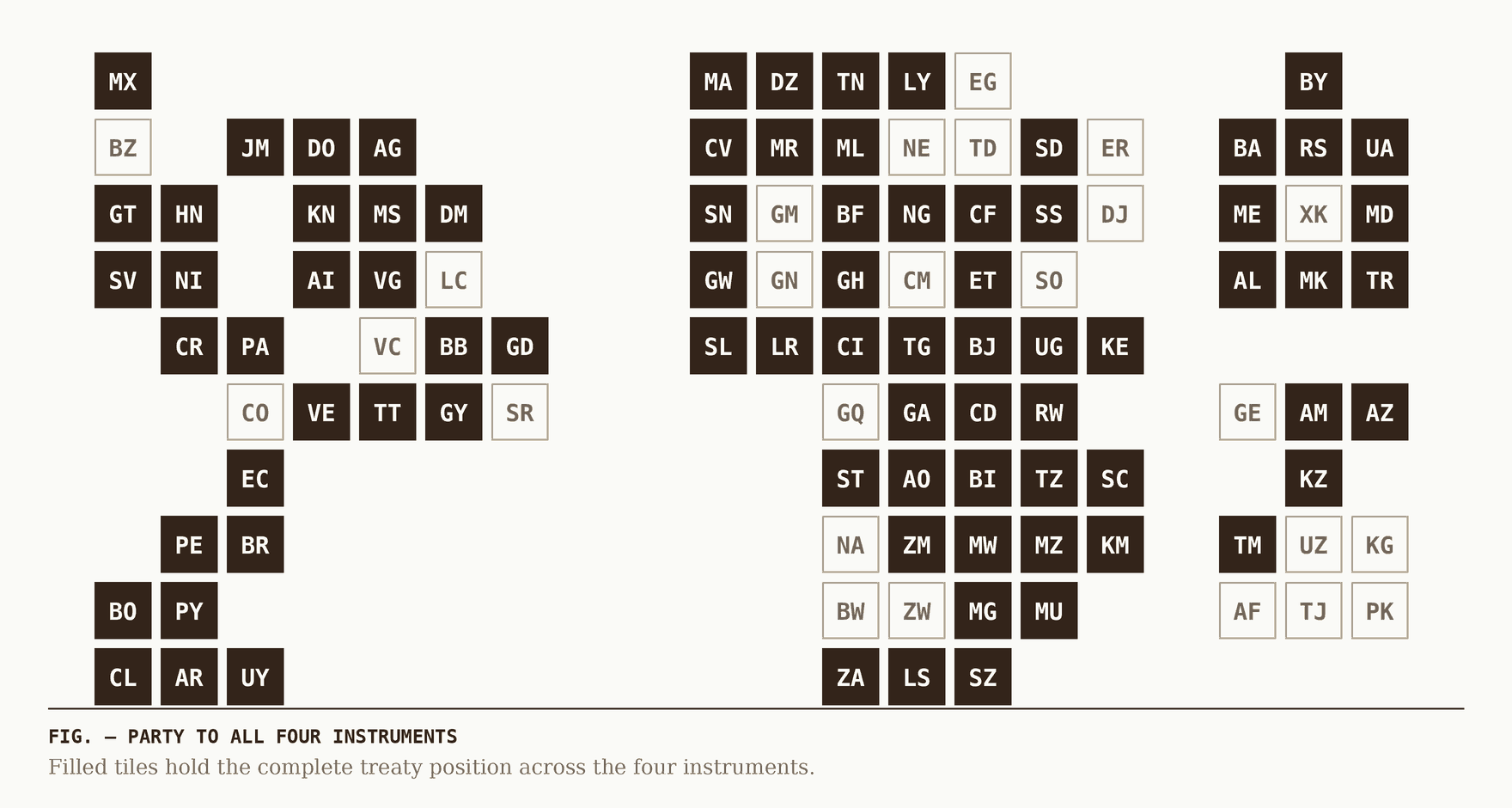
Ratification across this dataset is close to uniform for three of the four. The Firearms Protocol is the exception: 23 of the 106 jurisdictions are not parties to it, and a state in that position will typically have narcotics legislation with no equivalent marking or tracing regime for small arms.
Section 03
Measurement
Why illicit financial flows resist measurement
Every headline figure for illicit financial flows is an estimate built on a proxy, because the thing being measured is defined by not being recorded. The two common proxies measure different phenomena: trade-gap analysis compares what one country reports exporting against what its partner reports importing, and balance-of-payments analysis looks for capital movement that the accounts cannot explain. Neither isolates criminal proceeds from commercial tax avoidance, and the trade-gap method also captures ordinary reporting error, freight and insurance timing, and currency conversion.
The practical consequence for a reader is to treat any single global total with suspicion and to ask which method produced it. No aggregate estimate appears anywhere in this register for that reason. What the register carries instead is the legal position per jurisdiction, which is verifiable: the jurisdiction index records the treaty dates, the national instruments where a register confirms them, and the current monitoring status.
Section 05
Questions
Questions about illicit finance
What are illicit financial flows?
The term covers money that is illegally earned, illegally transferred or illegally used as it crosses a border. It therefore spans three quite different origins — the proceeds of crime, the proceeds of corruption, and commercial flows that evade tax or exchange controls — which is why estimates of its scale vary by an order of magnitude depending on which of the three the estimator counted.
What is the difference between money laundering and illicit financial flows?
Money laundering is a specific offence: disguising the origin of criminal proceeds so they can be used openly. Illicit financial flows is a broader descriptive category that includes laundering but also covers commercial mis-invoicing and unrecorded capital movement that may never be prosecuted as laundering. One is a charge a prosecutor brings; the other is a measurement problem.
Why does beneficial ownership matter so much in this area?
Because the legal owner of a company and the person who controls it are frequently different, and only the second is useful to an investigator. Where a registry records the first and not the second, tracing a payment stops at a corporate name. This is the deficiency most often cited when a jurisdiction is placed under increased monitoring, and the reform most often required of it before removal.
Which conventions cover money laundering?
Three of the four instruments tracked here reach it from different directions. The 1988 Convention requires criminalising the laundering of drug proceeds specifically; UNTOC extends that to the proceeds of serious organised crime generally; UNCAC covers the proceeds of corruption and adds the asset-recovery machinery for returning them. 81 of the 106 jurisdictions in this dataset are party to all four.