Section 10
Environmental crime
Same corridors, different legal framework.
Environmental crime: wildlife, timber, minerals and waste flows
Wildlife, timber, minerals and waste move through the ports, the intermediaries and the documentary systems described everywhere else on this site. What differs is the law they fall under: largely regulatory rather than criminal, frequently administered by an agency with no investigative powers, and outside the four instruments that carry the rest of this dataset. That mismatch — identical method, weaker framework — is the whole of the problem.
Four flows with one method
Wildlife moves as mis-declared cargo and in personal baggage, with the high-value trade in derivatives rather than live animals. Timber moves as legitimate commodity shipments whose species or origin is misstated, often laundered through a processing country that issues its own certificates. Minerals move through the same corridors as timber and are laundered the same way, by acquiring documentation in a neighbouring state that legitimises them for onward export. Waste travels in the opposite direction to the others — from wealthier jurisdictions to poorer ones — declared as recyclable material or second-hand goods.
In each case the concealment is documentary rather than physical. Nothing is hidden in a compartment; a form says one thing and the container holds another, which is the same mechanism set out on the trade-based laundering page, applied to goods instead of value.
Why the legal framework is weaker
The instruments tracked on this site create offences for drug trafficking, organised criminal participation, corruption and firearms trafficking. None creates an environmental offence. What reaches these flows internationally is UNTOC, and only conditionally: its cooperation machinery applies to serious crime, defined by a penalty threshold in the state where the conduct occurred.
That produces the characteristic failure. A state that classifies illegal logging as an administrative matter punishable by a fine has placed it below the threshold, so mutual legal assistance and extradition are unavailable for it — not because anyone objects, but because the conduct does not qualify. The same shipment, reclassified as fraud or as an organised-crime offence, does qualify, which is why cases in this area are so often built on the paperwork offence rather than on the environmental one.
Where it meets the rest of this dataset
Three overlaps are worth naming. The corridors are shared: the routes set out on the corridor profiles carry these commodities alongside narcotics, and a port control unit examining a container is examining it for whatever is wrong with it. The financial leg is shared: proceeds move through the same mis-invoicing and ownership structures described under illicit finance. And the enforcement techniques are shared — a controlled delivery works the same way whether the consignment is a narcotic or a protected species.
What is not shared is the record. This site publishes no environmental-crime layer on its jurisdiction records, because the sourcing standard applied to drug and firearms statutes could not be met for environmental legislation across 106 jurisdictions: the instruments are scattered across forestry, fisheries, mining and customs codes rather than concentrated in a single act, and confirming them would mean asserting a completeness this dataset does not have. That absence is deliberate and is recorded under sources and methodology.
Questions
What counts as environmental crime here?
Four flows that cross borders in commercial channels: protected wildlife and its derivatives, illegally harvested timber, minerals extracted or exported outside the licensing regime, and waste shipped to jurisdictions that cannot lawfully receive it. What they share is not ecology but method — each moves as mis-declared cargo through the same ports and the same paperwork as everything else on this site.
Why is environmental crime treated as a trafficking subject?
Because the constraint on it is the same one. A container of illegally harvested timber and a container of cocaine present customs with the same problem: a declaration that cannot be verified against the contents without an inspection nobody has capacity to perform. The commodity differs and the concealment does not.
Do the conventions on this site cover environmental crime?
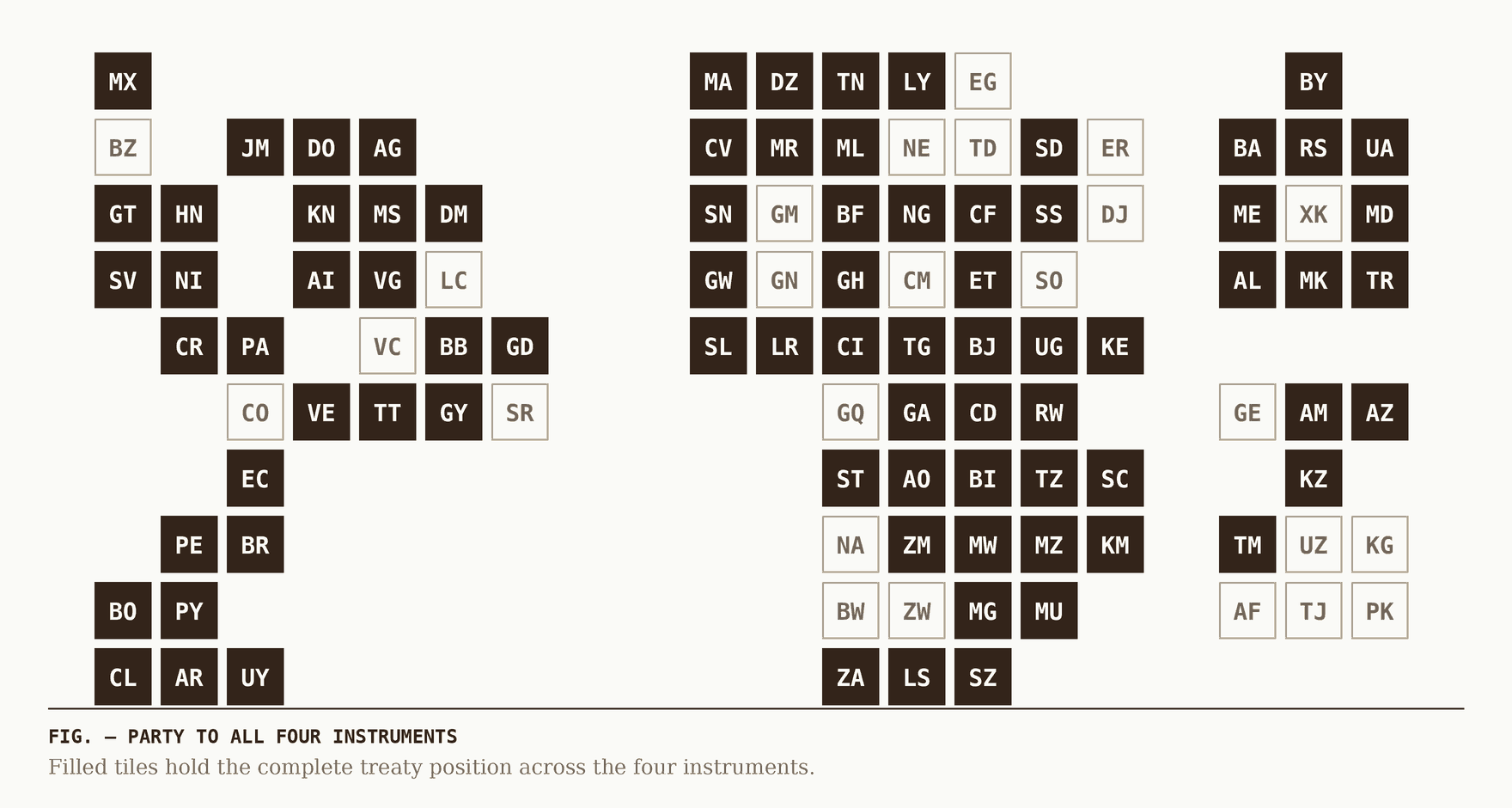
Not directly. None of the four instruments tracked here — to which 81 of the 106 jurisdictions are party — creates an environmental offence. UNTOC reaches these flows only where an organised criminal group is involved and the offence is serious under domestic law, which makes domestic classification the hinge on which international cooperation turns.
Why does penalty level matter so much in this area?
Because it decides whether cooperation is available at all. Mutual legal assistance and extradition under UNTOC generally require the conduct to be a serious offence, defined by a minimum penalty threshold. A state that treats illegal logging as a regulatory infringement with a fine has placed it below that line, and no amount of goodwill produces a joint investigation for conduct that is not a serious crime where it happened.