Section 06
Firearms
83 of 106 are parties to the Protocol.
Arms trafficking: small arms diversion and the Firearms Protocol gap
Arms trafficking is less a smuggling problem than a leakage problem. The overwhelming majority of weapons in illicit circulation were manufactured lawfully and entered legal ownership somewhere before leaving it — from a state armoury, a licensed dealer, a demobilised force or a security contract. Small arms trafficking therefore begins with a record that stops, and the illicit firearms trade that follows is supplied almost entirely from stock already in circulation. The Firearms Protocol, the instrument written around that problem, is accordingly a framework about record-keeping more than about weapons.
Section 01
Diversion
Diversion: how small arms leave legal control
Diversion happens at identifiable points, and each has a different remedy. Stockpile leakage is the largest: state holdings that are inaccurately inventoried, poorly secured, or retained long after any operational need. Transfer diversion occurs when an authorised export reaches a different end user than the licence names, which end-use certification is meant to prevent and frequently does not. Retail diversion runs through licensed dealers and straw purchasers. Battlefield capture and post-conflict recirculation supply the rest.
What unites them is that the weapon was, at the moment of diversion, someone's documented property. Small arms trafficking is in this sense a failure of custody rather than of borders. This is why arms trafficking investigations are archival before they are operational: the question is not where the weapon came from in general but which record it left.
Section 02
The instrument
Protocol against the Illicit Manufacturing of and Trafficking in Firearms, Their Parts and Components and Ammunition. Chapter XVIII-12-c.
What the Firearms Protocol requires
The Firearms Protocol supplements the Convention against Transnational Organized Crime and was adopted in 2001. A party undertakes criminalising illicit manufacturing and trafficking in firearms, marking weapons at manufacture and import so they can be traced, keeping records for at least ten years, and licensing or authorising every transfer. Those four duties — criminalise, mark, keep records, license every transfer — are a single mechanism rather than a list: marking makes tracing possible, records make marking useful, and licensing creates the documentary trail that a trace follows backwards. Nothing in the Firearms Protocol requires a state to restrict who may own a weapon; it requires the state to know where each one went.
Where a state is not a party, there is no treaty obligation to mark or trace weapons, so a firearm recovered at a crime scene may have no route back to its point of diversion — the single most common reason a trafficking chain cannot be reconstructed. That is the practical content of the ratification gap, and unlike the other three instruments in this dataset the gap is substantial.
Table 6.1
Non-parties
23 of 106 jurisdictions.
Which jurisdictions are not parties
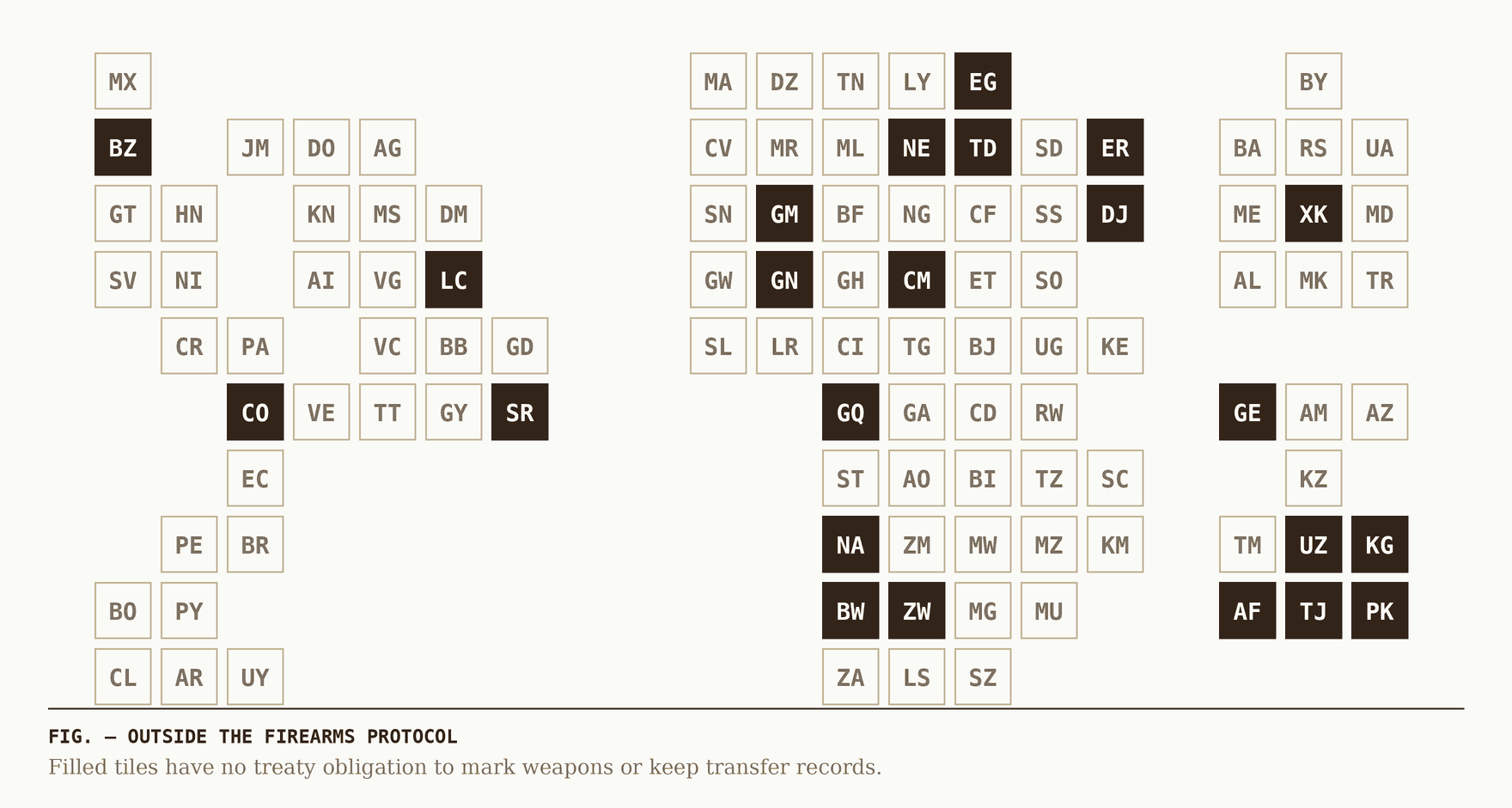
83 of the 106 jurisdictions covered here are parties to the Protocol. The 23 that are not cluster regionally rather than scattering, which matters on a corridor: a route whose legs are largely non-parties has no common tracing obligation along its length, whatever each state's domestic law says.
Africa — 12
Botswana · Cameroon · Chad · Djibouti · Egypt · Equatorial Guinea · Eritrea · Gambia · Guinea · Namibia · Niger · Zimbabwe
Balkans and eastern Europe — 1
Central Asia — 6
Afghanistan · Georgia · Kyrgyzstan · Pakistan · Tajikistan · Uzbekistan
Latin America and the Caribbean — 4
Belize · Colombia · Saint Lucia · Suriname
Section 03
Tracing
Tracing, and where the illicit firearms trade becomes invisible
A trace runs backwards from a recovered weapon through its marks to the manufacturer, then forward again through export licences and dealer records to the last documented holder. Every step depends on a record someone was obliged to keep, which is why the illicit firearms trade becomes untraceable at precisely the points where that obligation is absent: an unmarked weapon, a destroyed dealer register, a state stockpile inventory that was never accurate, or a transfer through a jurisdiction with no licensing requirement to document it.
The consequence is that arms trafficking cases are usually built on the paperwork of legitimate commerce rather than on the criminal transaction itself — the same structural feature that makes trade-based money laundering hard to prosecute. Each jurisdiction's position, including whether any firearms instrument has been confirmed against its own register, is on its record in the jurisdiction index.
Section 04
Questions
Questions about arms trafficking
What is arms trafficking?
The movement of weapons outside the licensing and authorisation system that is supposed to control them. In practice most of it is not manufacture-to-market smuggling but diversion: weapons that entered legal circulation somewhere — a state stockpile, a licensed dealer, a security contract — and left it at some point afterwards.
What does the Firearms Protocol actually require?
A party undertakes criminalising illicit manufacturing and trafficking in firearms, marking weapons at manufacture and import so they can be traced, keeping records for at least ten years, and licensing or authorising every transfer. Adopted in 2001, it supplements the Convention against Transnational Organized Crime; 83 of the 106 jurisdictions in this dataset are parties, which makes it the least widely ratified of the four instruments tracked here.
Why does marking matter so much for small arms trafficking?
Because a weapon without a unique, durable mark cannot be traced back to the point where it left legal control, and that point is where the offence usually happened. A recovered firearm with an intact mark is evidence about a supply chain; the same firearm with the mark removed, or never applied, is evidence only about the person holding it.
Is the illicit firearms trade mostly newly manufactured weapons?
No. The stock in circulation is durable — a rifle remains serviceable for decades — so the illicit firearms trade is dominated by weapons already in existence rather than by new production. That is why stockpile management and record-keeping matter more to supply than manufacturing controls do.