Trade based money laundering (TBML): the red flags and detection
Trade based money laundering moves criminal value through the international trade system by misstating the price, quantity or quality of goods on shipping documents. The trade based money laundering red flags set out below are cumulative rather than individually decisive, because TBML's advantage over every other method is that almost nothing about it is fake: there is a real exporter, a real container, a real bank and a real payment. Only a number is wrong, and no single institution in the chain can see both ends of the trade well enough to know which number it is.
Section 01
Mechanism
The mechanics: how trade mis-invoicing moves value
Trade mis-invoicing works because an invoice is an assertion, not a measurement. If an exporter bills a related importer one million for goods worth six hundred thousand, four hundred thousand has crossed a border with a customs declaration and a bank record behind it. Reverse the direction and under-invoicing achieves the same transfer the other way. Neither requires a false shipment; the goods can be exactly what the manifest says.
The variants follow from that. Multiple invoicing bills one consignment several times, usually through different banks, so that each payment references something real. Over- and under-shipment alter the quantity rather than the price. Phantom shipping is the degenerate case where the paperwork exists and the cargo does not, which is the easiest form to catch and therefore the least used by anyone competent.
What makes trade mis-invoicing durable is the asymmetry of records. The exporter's customs authority sees an export declaration; the importer's sees an import declaration; the bank sees a documentary credit. Each holds one third of the picture, and the three are reconciled — if at all — long after settlement.
Table 4.2
Indicators
Trade based money laundering red flags
No single indicator below proves anything: each has an innocent explanation that occurs in ordinary commerce every day. Their value is cumulative, and the trade based money laundering red flags that matter in practice are the ones that co-occur on the same counterparty over time.
| Indicator | What it looks like |
|---|---|
| Price outside any defensible range | The unit price on the invoice cannot be reconciled with a market price for the same commodity, grade and quantity. Over-invoicing moves value to the exporter; under-invoicing moves it to the importer. Both are the same trick pointed in opposite directions. |
| Goods that do not match the trade | A commodity inconsistent with the stated business of either party, or with the trade route: high-value low-weight goods appearing on a bulk shipping lane, or a firm with no history in a sector suddenly trading in it at volume. |
| The same consignment invoiced more than once | Multiple invoicing pays for one shipment several times through different institutions. Because each payment references a genuine underlying shipment, each one survives inspection on its own. |
| Quantity that the shipping documents contradict | Over-shipment and under-shipment describe a mismatch between what the invoice says was sent and what the bill of lading or container weight supports. Phantom shipping is the limit case, where no goods move at all. |
| Payment routed away from the counterparties | Settlement to or from a third party in an unrelated jurisdiction, particularly where the payer has no documented interest in the trade. The commercial rationale is usually absent rather than merely unclear. |
| Documentation that is too clean or inconsistent | Amended letters of credit, documents presented late in a pattern, or paperwork whose formatting differs from the same counterparty's previous filings. Individually trivial; as a pattern, the most common way a case is first noticed. |
Section 02
Detection
Detection: what actually surfaces a case
Detection divides into three approaches with very different costs. Unit-price screening compares a declared price against a reference range for the same commodity code and flags the outliers; it is cheap, automatable, and generates a large volume of false positives because legitimate pricing varies by grade, contract term and season. Trade-gap analysis compares what one country reports exporting against what its partner reports importing; it is useful at the level of a corridor and almost useless at the level of a shipment.
The third is document and counterparty analysis, and it is the one that produces cases. It asks whether this party's trade makes commercial sense as a whole: consistency between shipments, between the goods and the business, between the settlement route and the counterparties. That requires records held by a bank, a customs administration and often a foreign authority — which is why detection is an institutional problem before it is an analytical one, and why the bodies named on each jurisdiction record matter to whether a case can be built at all.
Section 03
Legal basis
TBML and the legal framework behind a prosecution
There is no standalone offence called TBML in most statute books, and no charge sheet uses the abbreviation. A case is brought as money laundering, with the trade documents as the mechanism and a predicate offence underneath — trafficking, corruption, fraud or tax evasion. That structure has a consequence: the strength of the laundering charge depends on how broadly the jurisdiction defines its predicate offences, which is set by the conventions it has ratified and the statute that implements them.
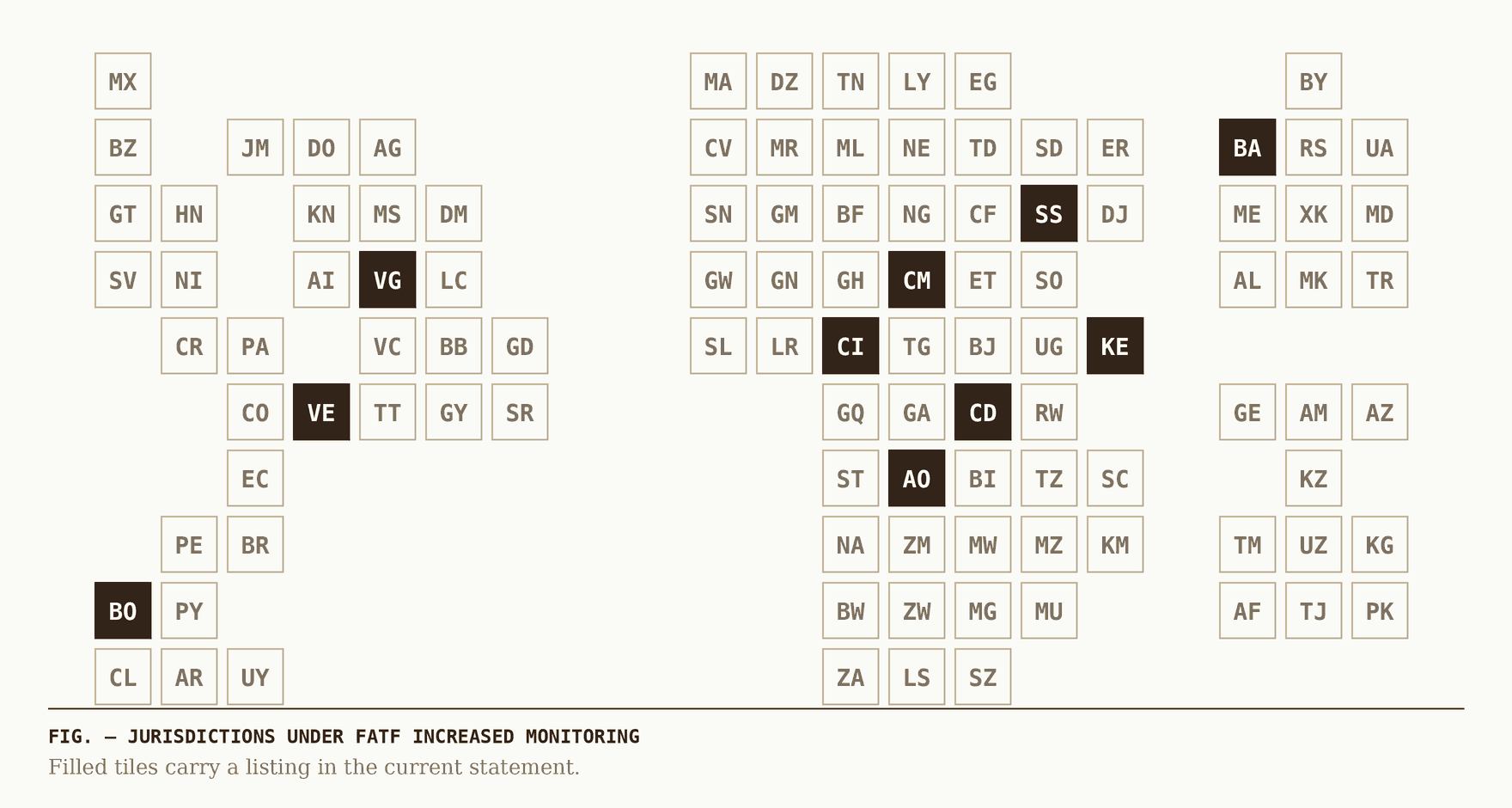
The relevant obligations are set out on the illicit finance page, and each jurisdiction's position — treaty dates, national instruments where a register confirms them, and current monitoring status — is on its own record. Where a state's laundering offence reaches only drug proceeds, a mis-invoicing scheme funded by customs fraud may not be chargeable as laundering at all.
Section 04
Questions
Questions about trade based money laundering
What is trade based money laundering?
It is the movement of criminal value through the international trade system by misrepresenting the price, quantity or quality of goods on trade documents. The payment that follows is legitimate on its face — a bank sees an invoice, a shipment and a settlement — so the laundering sits in the gap between what the documents say and what actually moved.
How is TBML different from other money laundering methods?
Most laundering methods try to make criminal money look like ordinary money. TBML does something harder to detect: it uses a genuine commercial transaction as the carrier, so there is a real shipment, a real counterparty and a real bank payment. Nothing has to be faked except a number on a document, and no single institution sees both ends of the trade.
What are the main trade based money laundering red flags?
Price that cannot be reconciled with a market rate, goods inconsistent with the parties' business, the same consignment invoiced more than once, quantities the shipping documents contradict, settlement routed through an unrelated third party, and documentation patterns that differ from the counterparty's own history. The full set with explanations is above.
Why is trade mis-invoicing so hard to prosecute?
Because proving it requires records from both ends of a transaction that sit in different jurisdictions under different disclosure rules, and because a wrong price is not by itself an offence — commercial pricing varies legitimately. The case has to establish intent and a predicate offence, which usually means mutual legal assistance and a timeframe measured in years.