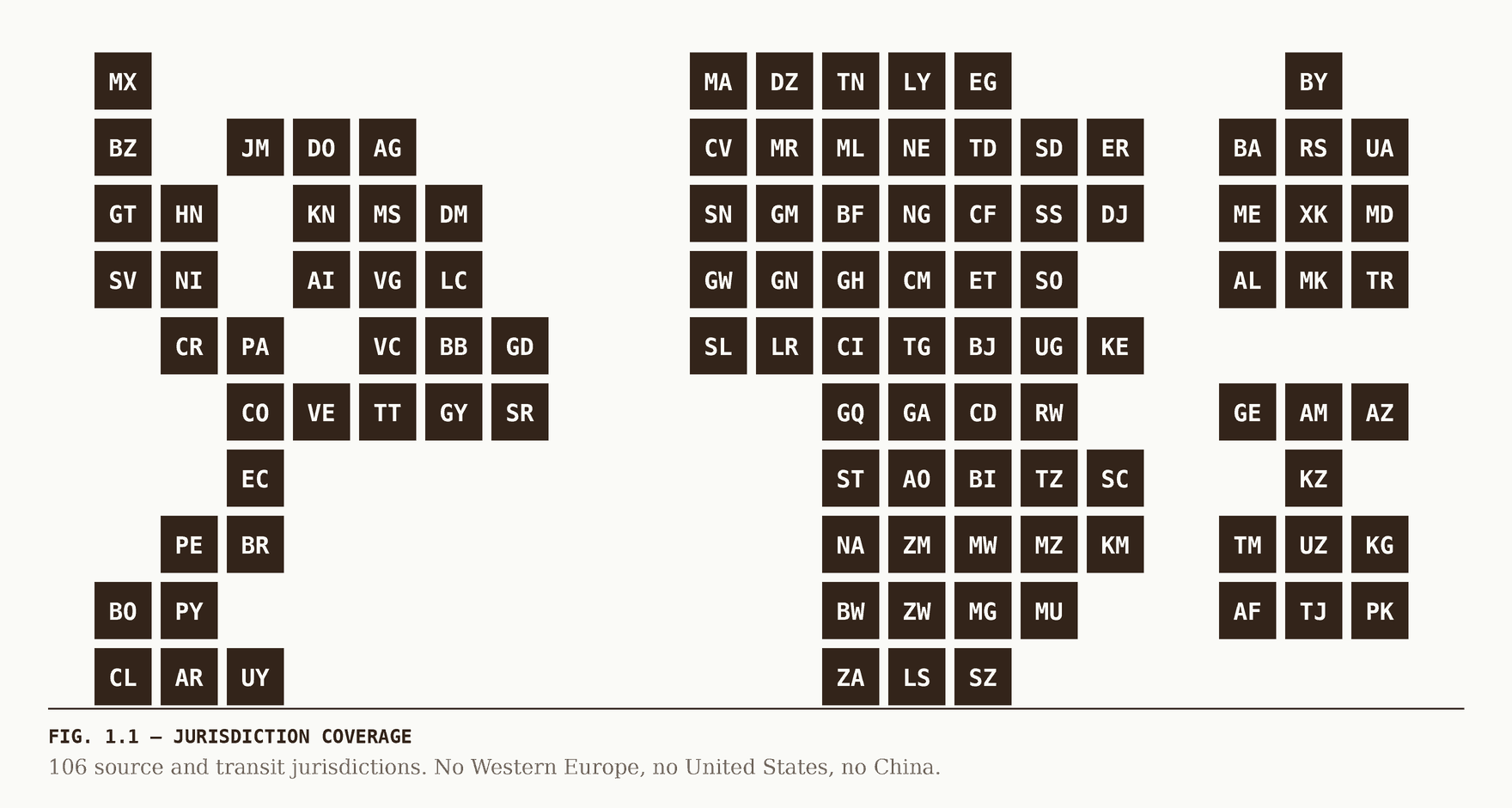
Fig. 1.1
Jurisdiction coverage
106 source and transit jurisdictions. Sources named per record.
Illicit trade: trafficking, illicit finance and enforcement response
A reference on illicit trade — the named illicit trade routes that carry contraband, the value those flows generate, and the law that is supposed to stop both. The centre of it is a jurisdiction dataset: for each of 106 source and transit countries and territories, what the drug and firearms statutes actually are, which conventions the state has ratified, and where its record sits in the international monitoring process. Illicit goods and illicit money are treated as one subject here, because the same corridors, intermediaries and documents carry both.
Reading tip for German readers: deutsche online casinos, a guide by Praxistipp.
Hatching
Section 02
Where the flows run
Where the illicit trade routes run
The illicit trade routes covered here are the named corridors that carry narcotics, weapons and the proceeds of both: three heroin corridors out of Afghan production and three cocaine corridors out of the Andes. A corridor is a sequence of jurisdictions with exploitable differences between them rather than a line on a map, which is why illicit trade routes are described on the corridors page by the legal orders they cross. Illicit goods move along them in ordinary commercial channels — containers, trucks, coastal vessels — and the documents that accompany those channels are where most of the concealment happens.
Table 2.1
Under increased monitoring
10 of 106. Revised three times a year.
Illicit finance: jurisdictions under increased monitoring
10 of the 106 jurisdictions in this dataset are currently on the Financial Action Task Force's increased-monitoring list. The list is revised at the February, June and October plenaries, so this is the part of the record that moves. The full index carries all 106.
| Jurisdiction | Region | Conventions ratified | Source tier |
|---|---|---|---|
| Angola | Africa | 4 of 4 | A |
| Bolivia | Latin America and the Caribbean | 4 of 4 | A |
| Bosnia and Herzegovina | Balkans and eastern Europe | 4 of 4 | A |
| British Virgin Islands | Latin America and the Caribbean | 4 of 4 | C |
| Cameroon | Africa | 3 of 4 | A |
| Côte d'Ivoire | Africa | 4 of 4 | A |
| Democratic Republic of the Congo | Africa | 4 of 4 | B |
| Kenya | Africa | 4 of 4 | A |
| South Sudan | Africa | 4 of 4 | B |
| Venezuela | Latin America and the Caribbean | 4 of 4 | A |
Section 03
Subject areas
Trafficking, enforcement and the other subject areas
Illicit finance
How value moves when it cannot move openly: trade mis-invoicing, shell ownership, cash-intensive intermediaries, and the FATF process that scores each jurisdiction on how well it can see any of it.
Read the briefingDrug routes
The named corridors — the Balkan, southern and northern heroin routes, the three Atlantic cocaine corridors — with what the reporting actually says about volumes and chokepoints.
Read the briefingFirearms
Small arms diversion, stockpile leakage and the Firearms Protocol: which states have ratified it, what their marking and tracing law requires, and where the records stop.
Read the briefingEnvironmental crime
Wildlife, timber, minerals and waste — the flows that use the same corridors and the same intermediaries as everything else on this site, under a different legal framework.
Read the briefingEnforcement
Container control, airport interdiction, controlled delivery and mutual legal assistance: the mechanics of stopping a shipment and of prosecuting afterwards.
Read the briefingGrey markets
Licit goods in illicit channels: illicit tobacco, counterfeits and unlicensed online services, where the question is rarely legality in the abstract but licensing in a specific place.
Read the briefingQuestions about this reference
What does this site cover?
Drug and firearms law in 106 source and transit jurisdictions, with the treaty position, the national legislation confirmed against an official register, the current financial-monitoring status and the enforcement bodies named on each jurisdiction's own government hosts. 81 of the 106 are party to all four of the instruments tracked here and 91 carry at least one confirmed national instrument.
Why are the United States, China and western Europe not in the dataset?
Because the set is source and transit jurisdictions rather than a world index. Consumer markets are endpoints of the corridors described here, not legs of them, and including them would change what the comparisons mean without adding anything the corridor pages need. The coverage is 106 countries and territories across Africa, Latin America and the Caribbean, Central Asia and the Balkans.
What is in a jurisdiction record?
Four layers, each separately sourced and each dated. The ratification dates come from the depositary status tables; the national instruments are cited to an official register and linked to the document itself; the monitoring status comes from the current plenary statement; the enforcement bodies are confirmed on hosts tied to the jurisdiction. Where a layer could not be sourced the record says so and names where it was looked for, because an absence with provenance is a finding and a dash is not.
Why are there no figures for the value or volume of these flows?
Because the available ones do not measure what they are taken to measure. Seizure totals move with enforcement effort as much as with trafficking, and trade-gap estimates capture ordinary reporting error, freight timing and currency conversion alongside deliberate misstatement. Publishing a number derived from either would give a precision the method cannot support, so none of the 106 records carries one.
How current is the record?
Every line carries the date it was checked. The monitoring status moves three times a year, at the February, June and October plenaries, and 10 of the 106 jurisdictions are currently listed. Treaty positions change rarely but do change; 23 jurisdictions remain outside the Firearms Protocol, which is the one instrument here with a substantial ratification gap.