Section 09
Corridor profiles
6 corridors · 49 distinct jurisdictions.
Trafficking corridors: comparative profiles by route
The claim that a corridor is only as controlled as its weakest crossing is testable, and these profiles are where it gets tested. Each of the 6 named corridors is broken into its legs, and each leg is checked against the same three measures: treaty coverage, whether a national instrument could be confirmed against an official register, and current financial monitoring status. Together the corridors cross 49 distinct jurisdictions.
The comparison
Every figure below counts legs, not consignments. A high number in the last three columns describes a route along which the legal framework is uneven or unverified, which is a different statement from a route that carries more.
| Corridor | Commodity | Legs | Outside the Firearms Protocol | No confirmed statute | Under monitoring |
|---|---|---|---|---|---|
| The Balkan route | heroin | 8 | 2 | 0 | 1 |
| The northern route | heroin | 6 | 4 | 2 | 0 |
| The southern route | heroin | 7 | 1 | 2 | 1 |
| The West African corridor | cocaine | 12 | 3 | 1 | 1 |
| The Caribbean corridor | cocaine | 12 | 2 | 0 | 2 |
| The Central American isthmus | cocaine | 9 | 2 | 0 | 0 |
What the comparison shows
On these measures the northern route is the most exposed route in the dataset: 4 of its 6 legs are outside the Firearms Protocol and 2 carry no national instrument confirmed against a citable register. That combination is worth reading carefully, because the second figure is partly a statement about sourcing — some of those states publish their legislation somewhere this dataset could not reach — while the first is a matter of treaty record and is not in doubt.
The general pattern across all 6 corridors is that treaty coverage is strong and even, while the ability to point at a specific national instrument is neither. That asymmetry is the most useful single finding in the dataset: the international framework is close to universal here, and what varies between one leg of a route and the next is the domestic law that carries it into force. The mechanisms each corridor uses are described on the drug routes page, and the enforcement techniques that address them on the enforcement page.
Junction jurisdictions
4 of the 49 jurisdictions in these profiles sit on more than one corridor. They matter out of proportion to their number: a gap on a leg that carries a single route weakens that route, while the same gap at a junction weakens every route running through it, and a control improvement there pays back the same way.
| Jurisdiction | Corridors | Confirmed statute | FATF |
|---|---|---|---|
| Colombia | The West African corridor, The Caribbean corridor, The Central American isthmus | 3 confirmed | Not listed |
| Afghanistan | The Balkan route, The northern route | 1 confirmed | Not listed |
| Pakistan | The Balkan route, The southern route | 3 confirmed | Not listed |
| Venezuela | The West African corridor, The Caribbean corridor | 3 confirmed | Increased monitoring |
Questions
What is the difference between this page and the drug routes page?
The drug routes page explains how each corridor works — the transport mode, the chokepoints, why it persists. This one compares the corridors against each other on what the dataset can verify: how many legs are party to which instruments, how many carry a confirmed national statute, how many are under financial monitoring. One is description, the other is measurement.
How is a corridor defined here?
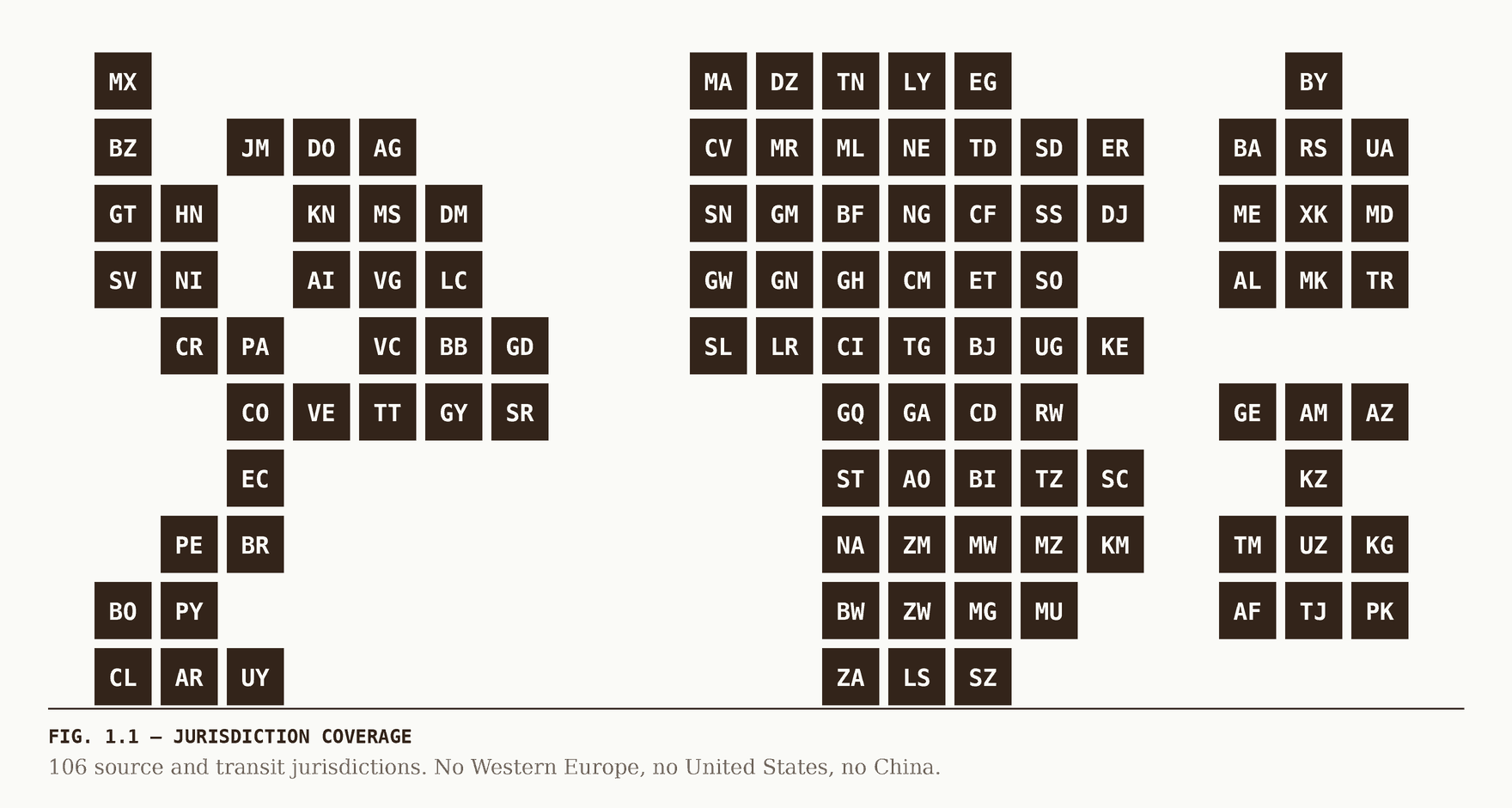
As an ordered set of jurisdictions, not as a line. Each corridor lists the states and territories the reporting places on it, and every one of those legs is a record in the 106-jurisdiction index. A corridor with no legs in the dataset would not appear at all, which is why consumer markets in western Europe and North America are absent: they are endpoints, and this dataset covers source and transit jurisdictions.
Why does the same jurisdiction appear on more than one corridor?
Because it genuinely sits on more than one. A few jurisdictions are junctions: they appear as a leg of several corridors, which is not double counting but the structural fact that makes them consequential — a legal gap in a junction degrades every route that crosses it, while the same gap in a terminal leg affects one. The corridor pages count distinct jurisdictions rather than legs for that reason.
Can these corridors be compared directly?
On the legal measures, yes — the same three checks are applied to every leg of every route. On volume or importance, no: this site publishes no tonnage estimates, because the available figures derive from seizures and trade gaps that measure enforcement activity and reporting error alongside the thing they are taken to measure.