Corridor profile
9 legs · cocaine · 0 under monitoring.
The Central American isthmus: jurisdictions crossed and the law
The land and littoral corridor from the Andean producing countries through the isthmus towards North America. It is the most heavily policed corridor in the dataset and the one where displacement is best documented: pressure at one crossing reliably moves the traffic to the next rather than reducing it.
Why the legal profile of a corridor matters
A corridor is only as controlled as its most permissive crossing. That is easy to assert and hard to check, because it requires knowing what each state along the route is actually bound to do and what its own law provides — which is what this page sets out. The narrative account of how the route works is on the drug routes page; what follows here is the record, leg by leg.
Of the 9 jurisdictions on this corridor, 7 are party to all four instruments tracked on this site and 2 are not party to the Firearms Protocol. 0 carry no national instrument confirmed against a citable register, and 1 names no enforcement authority confirmed on their own government domain. Those last two are statements about what could be sourced, not about what exists — the distinction is set out under sources and methodology.
The legs
| Jurisdiction | Conventions | Firearms Protocol | FATF | Tier |
|---|---|---|---|---|
| Colombia | 3 of 4 | not a party | Not listed | A |
| Panama | 4 of 4 | 18 Aug 2004 | Not listed | A |
| Costa Rica | 4 of 4 | 9 Sep 2003 | Not listed | A |
| Nicaragua | 4 of 4 | 2 Jul 2007 | Not listed | A |
| Honduras | 4 of 4 | 1 Apr 2008 | Not listed | A |
| El Salvador | 4 of 4 | 18 Mar 2004 | Not listed | A |
| Guatemala | 4 of 4 | 1 Apr 2004 | Not listed | A |
| Belize | 3 of 4 | not a party | Not listed | A |
| Mexico | 4 of 4 | 10 Apr 2003 | Not listed | A |
The instruments in force along this corridor
13 national instruments are confirmed against an official register across the 9 legs of this corridor. Read together they are the statutory basis on which anything charged along the route has to rest, and the unevenness between them is the reason a case built in one jurisdiction can fail in the next.
| Jurisdiction | Instrument | Confirmed on |
|---|---|---|
| Colombia | Ley 30 de 1986 | funcionpublica.gov.co |
| Colombia | Ley 600 | unodc.org |
| Colombia | Decreto Numero 2467 De 2015 | unodc.org |
| Panama | Law 23 | unodc.org |
| Panama | LEY-20-DE-1993-G.O.-22429.pdf | ministeriopublico.gob.pa |
| Costa Rica | Law No. 8204: Complete Revision of the Law on Narcotics, Psychotropic Substances, Drugs of Unauthorized Use and Related Activities | unodc.org |
| Nicaragua | Ley Nº 510 sobre el Control y Regulación de Armas de Fuego, Municiones, Explosivos y Otros Materiales Relacionados | poderjudicial.gob.ni |
| Honduras | Ley sobre uso indelbido y trafico ilicito de drogas y sustancias psicotropicas | unodc.org |
| El Salvador | Ley Reguladora De Las Actividades Relativas A Las Drogas Del 5 De Marzo De 1991 | asamblea.gob.sv |
| Guatemala | Ley contra la Narcoactividad (Decreto 48-92) | www.oas.org |
| Guatemala | Ley contra el Lavado de Dinero u Otros Activos | www.oas.org |
| Belize | Firearms (Amendment) Act of 2018 | bco.gov.bz |
| Mexico | Código Penal Federal | www.unodc.org |
Where the route is weakest on paper
Tracing. Colombia, Belize are not party to the Firearms Protocol, so along those legs there is no treaty obligation to mark weapons at import or to keep transfer records. Where there is no treaty obligation to mark or trace weapons, a weapon crossing here can lose its documented history without anyone breaking a rule.
Questions
Which jurisdictions does the central american isthmus cross?
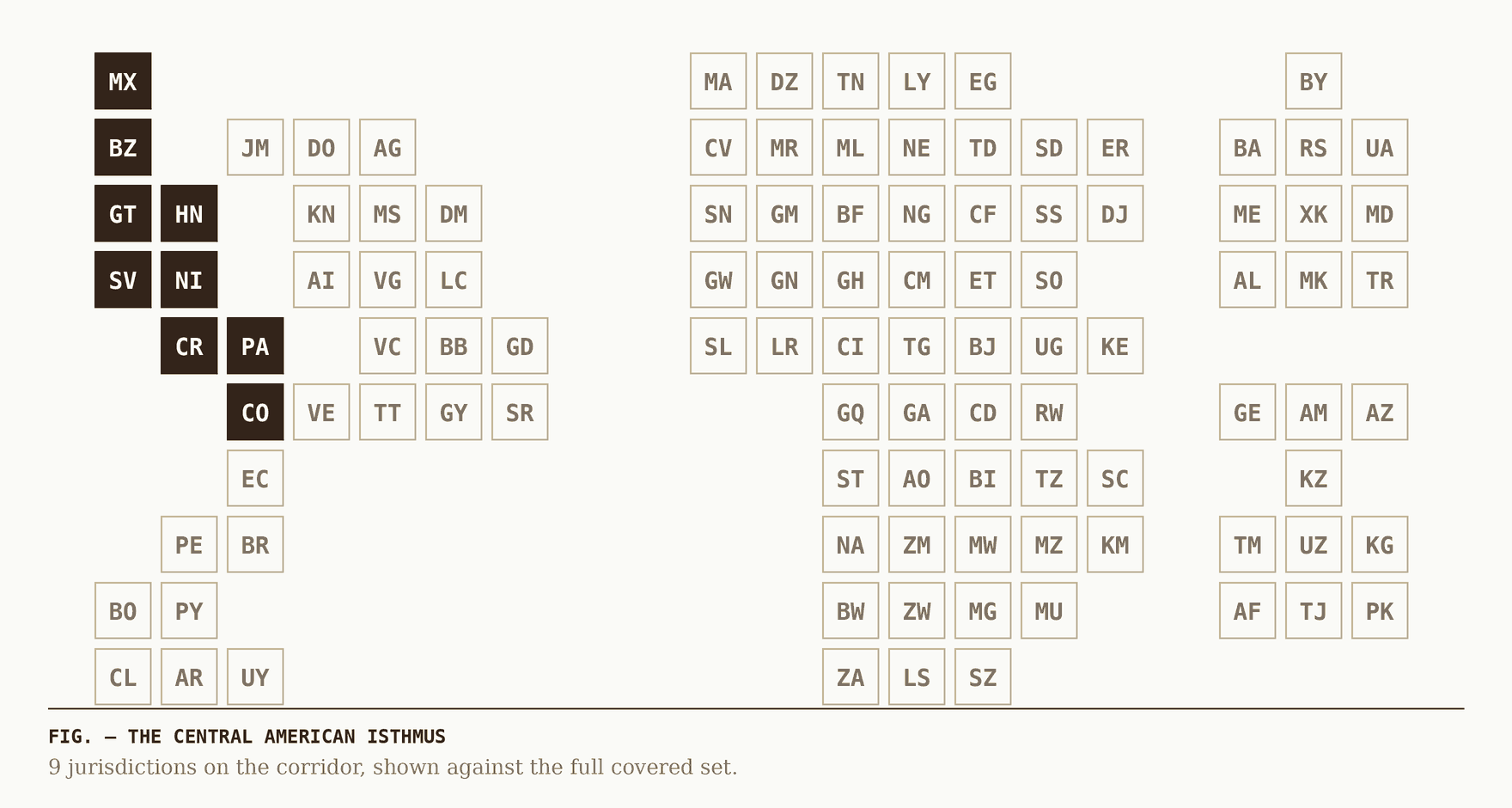
9 of the jurisdictions covered on this site: Colombia, Panama, Costa Rica, Nicaragua, Honduras, El Salvador, Guatemala, Belize, Mexico. Each has a record setting out its treaty position, any national instrument confirmed against an official register, and its current standing in the monitoring process.
Is the legal framework consistent along this route?
No route in this dataset is uniform. On this one, 7 of the 9 legs are party to all four instruments, 2 are outside the Firearms Protocol, and 0 carry no national instrument confirmed against a citable register. Those differences are what a corridor exploits — the traffic settles where the combination is most permissive.
Which leg of the central american isthmus is the weakest on the record?
On the three checks this dataset can apply — Firearms Protocol coverage, a confirmed national instrument and current monitoring status — Colombia carries the most gaps of any leg on this corridor. That is a statement about what can be verified, not a ranking of enforcement: a jurisdiction that publishes little scores worse than one that publishes badly. The record for each leg sets out which of the three is missing and why.
What does the monitoring status add to that picture?
None of the legs on this corridor is currently under FATF increased monitoring. That is a statement about identified deficiencies in financial controls, not a finding that the route is well policed — the two are assessed by different processes against different standards.