Section 07
Enforcement
Article 11, 1988 Convention. 103 of 106 are parties.
Controlled delivery: interdiction, container control and cooperation
A controlled delivery is the decision not to seize. Controlled delivery operations begin where an ordinary case would end: authorities have found an illicit consignment and, they may allow it to run on to its destination under surveillance rather than stopping it, on the reasoning that a seizure at the border catches a courier while a delivery caught at its destination catches the people who arranged it. It is the clearest case of a general rule in this field: interdiction that maximises seizures and interdiction that dismantles an organisation are different activities, and they frequently conflict. Controlled delivery operations are the technique built around choosing the second.
Section 01
The technique
How controlled delivery operations work
The mechanics are simple and the conditions are not. A consignment is identified, usually at a port or an airport. It is kept under continuous control — sometimes with the contraband replaced by an inert substitute, sometimes not — while it moves to its stated destination. Surveillance continues through delivery, and the arrests happen at the point of receipt, where the connection between the goods and an organisation is evidentially strongest.
Controlled delivery operations fail on prosaic things. The consignment is lost in transit. A second authority declines to let it cross. The receiving party does not appear, and the operation ends with less evidence than an ordinary seizure would have produced. Because the downside is a visible failure and the upside is a case that takes years to reach court, the institutional incentives run against the technique even where the law permits it.
Section 02
Legal basis
Article 11 and the treaty basis for interdiction
Article 11 of the United Nations Convention against Illicit Traffic in Narcotic Drugs and Psychotropic Substances is the provision that makes the technique available across borders. It obliges parties to take the measures necessary to permit the appropriate use of controlled delivery at international level, on the basis of agreements or arrangements between them, and leaves the decision in each case to the competent authorities of the states concerned.
Two things follow. First, the treaty creates a permission, not an obligation to run any particular operation: a state may always decline. Second, because it operates through agreements between authorities, the practical availability of the technique depends on whether those authorities have a working relationship, not only on whether both states have ratified. 103 of the 106 jurisdictions here are parties, so the treaty basis is nearly universal while the working relationships are not.
Section 03
Container control
Container control: interdiction as a selection problem
Almost nothing that crosses a border is inspected, and nothing about that will change: the volume of containerised trade makes physical examination of any meaningful fraction impossible. Container control is therefore a selection problem. Units profile consignments from manifest data, routing history, consignor and consignee records and intelligence, and produce a shortlist small enough to examine.
This is why the constraint is analytical rather than physical. A unit with scanners and no access to advance cargo data selects badly; a unit with the data and the authority to act on it selects well with modest equipment. It is also why container control is vulnerable in exactly the way described on the trade-based laundering page: both depend on the accuracy of documents that a party to the trade prepared.
Section 04
Cooperation
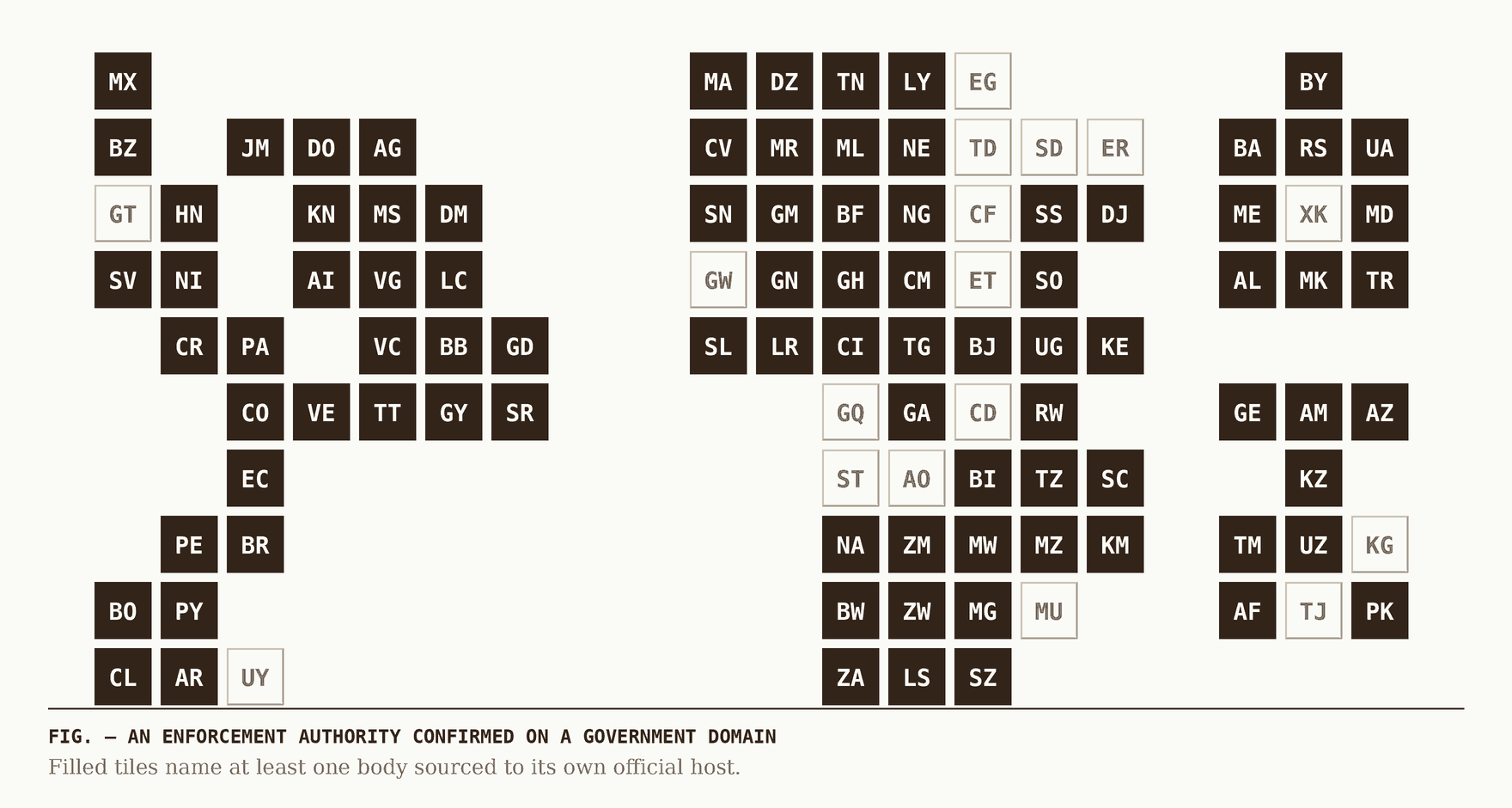
50 records name a customs body · 33 name a police service.
Cooperation: what a cross-border case actually requires
Cooperation is the binding constraint on nearly every technique on this page. A controlled delivery needs a counterpart authority willing to let contraband transit; a prosecution needs evidence gathered abroad, which means a mutual legal assistance request travelling through central authorities at a pace measured in months; an asset recovery needs a third state to restrain property before it moves again.
Which body holds which mandate therefore matters concretely, because a request sent to the wrong authority is a request that expires. 50 of the 106 jurisdiction records here name a customs administration and 33 name a police service, each confirmed on that jurisdiction's own government domain — those are set out on the individual records, alongside the treaty position that determines what can be asked of them.
Section 05
Questions
Questions about enforcement technique
What is a controlled delivery?
A technique in which authorities who have detected an illicit consignment allow it to continue to its destination under surveillance, instead of seizing it at the point of discovery. The purpose is to reach the people organising the shipment rather than only the courier carrying it, since a seizure at the border typically identifies nobody above the driver.
What is the legal basis for controlled delivery?
Article 11 of the United Nations Convention against Illicit Traffic in Narcotic Drugs and Psychotropic Substances obliges parties to take the measures necessary to permit the appropriate use of controlled delivery at international level, on the basis of agreements between them. 103 of the 106 jurisdictions covered here are parties to that convention, which is what makes the technique available across most of the corridors on this site.
Why are controlled delivery operations difficult to run across borders?
Because they require two or more authorities to agree, in advance and quickly, to let contraband move through their territory — accepting the risk that it is lost. That decision needs a legal basis, a channel to communicate on, and mutual trust that the other side will not simply seize it for its own statistics. Any one of the three being absent ends the operation.
How does container control work?
Container control is profiling rather than searching: a very small fraction of containers can be physically inspected, so units select targets from manifest data, routing anomalies, consignor history and intelligence. The output is a shortlist, and the constraint is almost never scanning equipment — it is analytical capacity and the quality of the data the unit is allowed to see.