About the data
106 records · 161 instruments · checked 2026-07-29.
Sources and methodology: how this dataset is built and checked
Every field on this site is either sourced or reported as absent. That sounds like a low bar and is not: the material this dataset covers — what a state's drug law actually says, which body enforces it — is widely restated and thinly sourced, and a reference work that repeats an unattributed claim adds authority to something that never had any. What follows is how each layer is established, and what is deliberately not published.
The three layers, and their different standards
A jurisdiction record combines three kinds of statement and they are not equally certain, so they are not sourced the same way.
Treaty position comes from the United Nations Treaty Collection status tables, which are the depositary's own record rather than a report about it. This is the strongest layer: a ratification date is a matter of registration, and there is exactly one authoritative source for it. All 106 records carry it.
Listing status comes from the Financial Action Task Force plenary statements, read in full. That reading matters: the June statement ends with a section naming jurisdictions no longer under monitoring, so a summary built from its headings inverts the status of the two states that were removed. All 106 records carry this layer too.
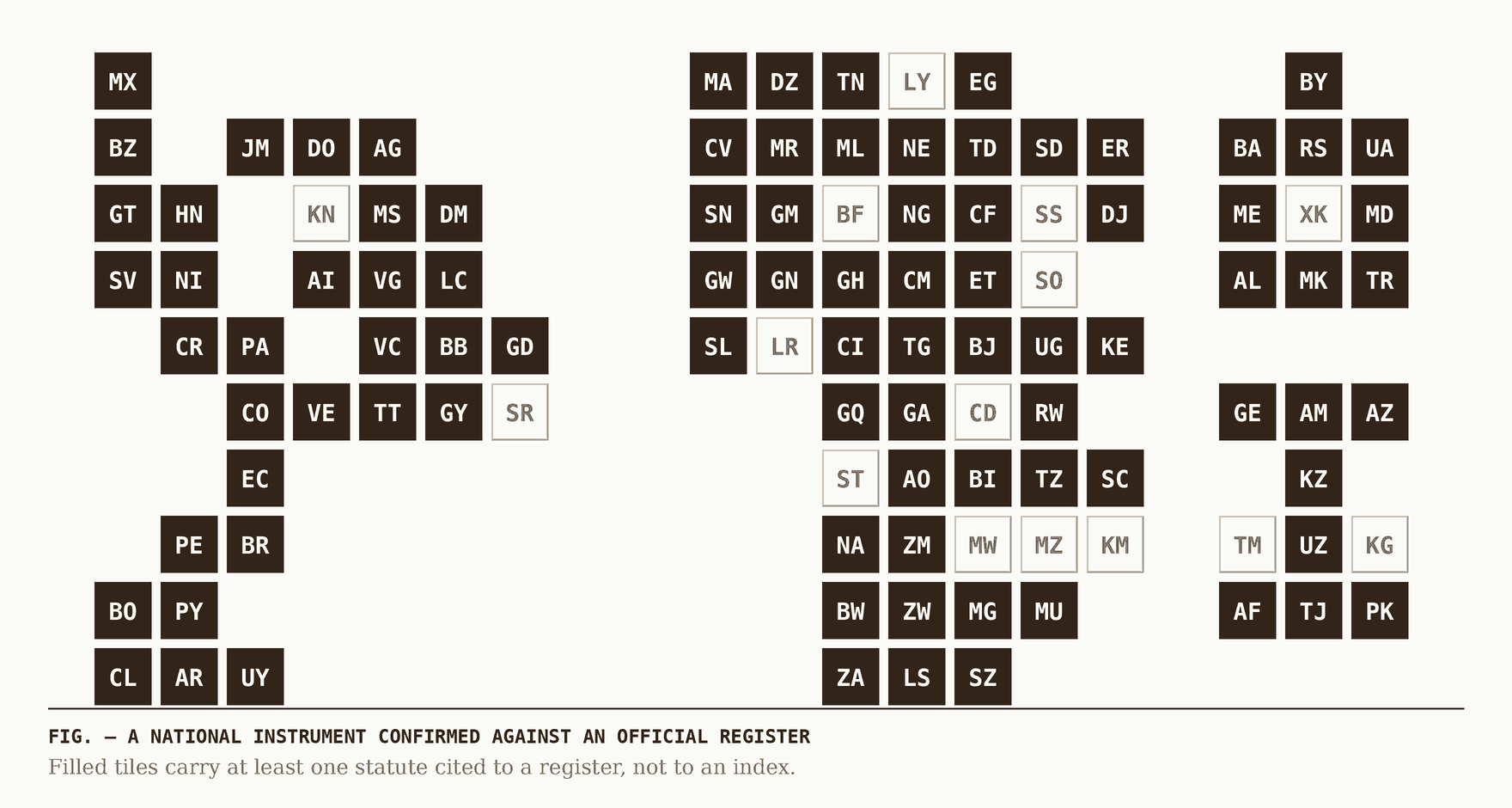
National legislation is the weakest layer and the most useful, so it has the most machinery around it. 91 of the 106 jurisdictions carry at least one instrument confirmed against an official register — 161 in total, 78 matched from an earlier index and 83 found on the register directly. The remaining records state that nothing was confirmed and name where it was sought.
Source tiers
The tier on each record describes the source path, not the depth of the page. It is keyed on whether a national instrument could be cited, because that is the distinction a reader needs.
| Tier | Meaning | Records |
|---|---|---|
| A | A national instrument is confirmed against an official register and cited on the page. | 88 |
| B | The treaty record is confirmed at the depositary; no national instrument could be confirmed against a citable register. A statement about this dataset's sourcing, not about the statute book. | 14 |
| C | A dependent territory, whose obligations arrive by extension from the metropolitan state rather than by its own accession — the accurate legal position, and one that is commonly misreported as non-ratification. | 4 |
The country-tie check
Confirming that an instrument exists is a different question from confirming that it belongs to the jurisdiction whose page will cite it, and the second is where a reference work does real damage if it is careless. An audit of the confirmed set found instruments that had passed the first test and failed the second: an ordinance attributed to one jurisdiction but cited to a New Zealand register, a money-laundering law cited to an Egyptian government host on a South American record, a firearms law cited to the Congress of a neighbouring state.
Every published instrument now carries a tie: the UNODC legal library files the document under the jurisdiction's ISO3 code, the host is the jurisdiction's own government domain, or an intergovernmental register names the jurisdiction in the document title. A host bearing another country's domain suffix is rejected regardless of how well the title matches. The same test is applied, more strictly, to the enforcement authorities named on 89 records — agency names such as "Customs and Excise Department" are shared across a dozen jurisdictions, so only a body's own government domain is accepted.
What is deliberately not published
Aggregate estimates of illicit financial flows and route tonnages are not published anywhere on this site. The credible figures are derived from trade gaps or from seizures, and neither isolates what a reader assumes it does — seizures measure enforcement activity as much as flow, and trade gaps capture ordinary reporting error alongside deliberate mis-invoicing.
Lists of programme participants are not published either. They are asserted by the index this domain inherited and confirmed by no official source, so programme dossiers describe the corridors a programme addresses and the jurisdictions on them instead. Where a programme itself could not be confirmed, its page says so rather than describing it.
Statute names that no register would confirm are held back entirely. That is the single largest category of withheld material, and it is why 14 records state an absence: an earlier index supplied the names, an earlier index is not a citation, and a statute stated wrongly with a citation attached is worse than a blank field by a wide margin.
Questions about the method
Where does the convention data come from?
The United Nations Treaty Collection status tables — the depositary's own record — for chapters VI-19, XVIII-12, XVIII-14, XVIII-12-c. Dates are taken as the depositary states them and are not rounded, inferred from a signature date, or carried over from a secondary summary.
How is a national statute confirmed?
By an official register that identifies the instrument: a government law portal, a parliamentary repository, a gazette, or the UNODC legal library, which reproduces national legislation. Two routes reach that bar — a name recovered from an earlier index and then matched against a register, or an instrument found on the register first. 161 instruments across 91 jurisdictions currently meet it.
What stops a statute from being attributed to the wrong country?
A separate check, applied after confirmation, requiring proof that the document belongs to the jurisdiction whose page will cite it: the UNODC path carries its ISO3 code, the host is its own government domain, or an intergovernmental document names it. A host carrying another country's domain suffix is rejected outright, whatever else matches.
Why do some records state that nothing was found?
Because an absence with provenance is a finding and a blank is not. Where no instrument could be confirmed, the record says so and names the registers that were searched. The alternative — printing a plausible statute name from an uncitable source — is the one error this dataset could not recover from, since the page would be stating law.
How current is this?
Convention and listing data were checked 2026-07-29. The FATF list is revised three times a year at the February, June and October plenaries and this site is rebuilt on that cycle. Statute confirmations carry their own check date on each record.