Corridor profile
6 legs · heroin · 0 under monitoring.
The northern route: jurisdictions crossed and their legal position
The same origin moving north through Central Asia. It crosses several jurisdictions whose drug legislation predates independence and whose borders were internal administrative lines within living memory, which is why the legal-framework question on this corridor is often one of statutory inheritance rather than of drafting.
Why the legal profile of a corridor matters
A corridor is only as controlled as its most permissive crossing. That is easy to assert and hard to check, because it requires knowing what each state along the route is actually bound to do and what its own law provides — which is what this page sets out. The narrative account of how the route works is on the drug routes page; what follows here is the record, leg by leg.
Of the 6 jurisdictions on this corridor, 2 are party to all four instruments tracked on this site and 4 are not party to the Firearms Protocol. 2 carry no national instrument confirmed against a citable register, and 2 name no enforcement authority confirmed on their own government domain. Those last two are statements about what could be sourced, not about what exists — the distinction is set out under sources and methodology.
The legs
| Jurisdiction | Conventions | Firearms Protocol | FATF | Tier |
|---|---|---|---|---|
| Afghanistan | 3 of 4 | not a party | Not listed | A |
| Tajikistan | 3 of 4 | not a party | Not listed | A |
| Uzbekistan | 3 of 4 | not a party | Not listed | A |
| Kyrgyzstan | 3 of 4 | not a party | Not listed | B |
| Turkmenistan | 4 of 4 | 28 Mar 2005 | Not listed | B |
| Kazakhstan | 4 of 4 | 31 Jul 2008 | Not listed | A |
The instruments in force along this corridor
8 national instruments are confirmed against an official register across the 6 legs of this corridor. Read together they are the statutory basis on which anything charged along the route has to rest, and the unevenness between them is the reason a case built in one jurisdiction can fail in the next.
| Jurisdiction | Instrument | Confirmed on |
|---|---|---|
| Afghanistan | Anti Money Laundering and Proceeds of Crime Law 2004 | www.unodc.org |
| Tajikistan | The Law of the Republic of Tajikistan "On Narcotic Drugs | unodc.org |
| Tajikistan | Law on Narcotic Drugs | unodc.org |
| Tajikistan | Decree of the President of the Republic of Tajikistan | unodc.org |
| Uzbekistan | 1994 Criminal Code of the Republic of Uzbekistan | unodc.org |
| Kazakhstan | Penal Code of the Republic of Kazakhstan | unodc.org |
| Kazakhstan | Penal Code | unodc.org |
| Kazakhstan | Kazakhstan Criminal Code 1997 (english) | unodc.org |
Where the route is weakest on paper
Tracing. Afghanistan, Tajikistan, Uzbekistan, Kyrgyzstan are not party to the Firearms Protocol, so along those legs there is no treaty obligation to mark weapons at import or to keep transfer records. Where there is no treaty obligation to mark or trace weapons, a weapon crossing here can lose its documented history without anyone breaking a rule.
Domestic instrument. Kyrgyzstan, Turkmenistan carry no national instrument confirmed against an official register in this dataset. That is a sourcing gap rather than a proven legislative one, but it has the same practical consequence for anyone trying to establish what is chargeable on that leg: the text cannot be pointed to.
Questions
Which jurisdictions does the northern route cross?
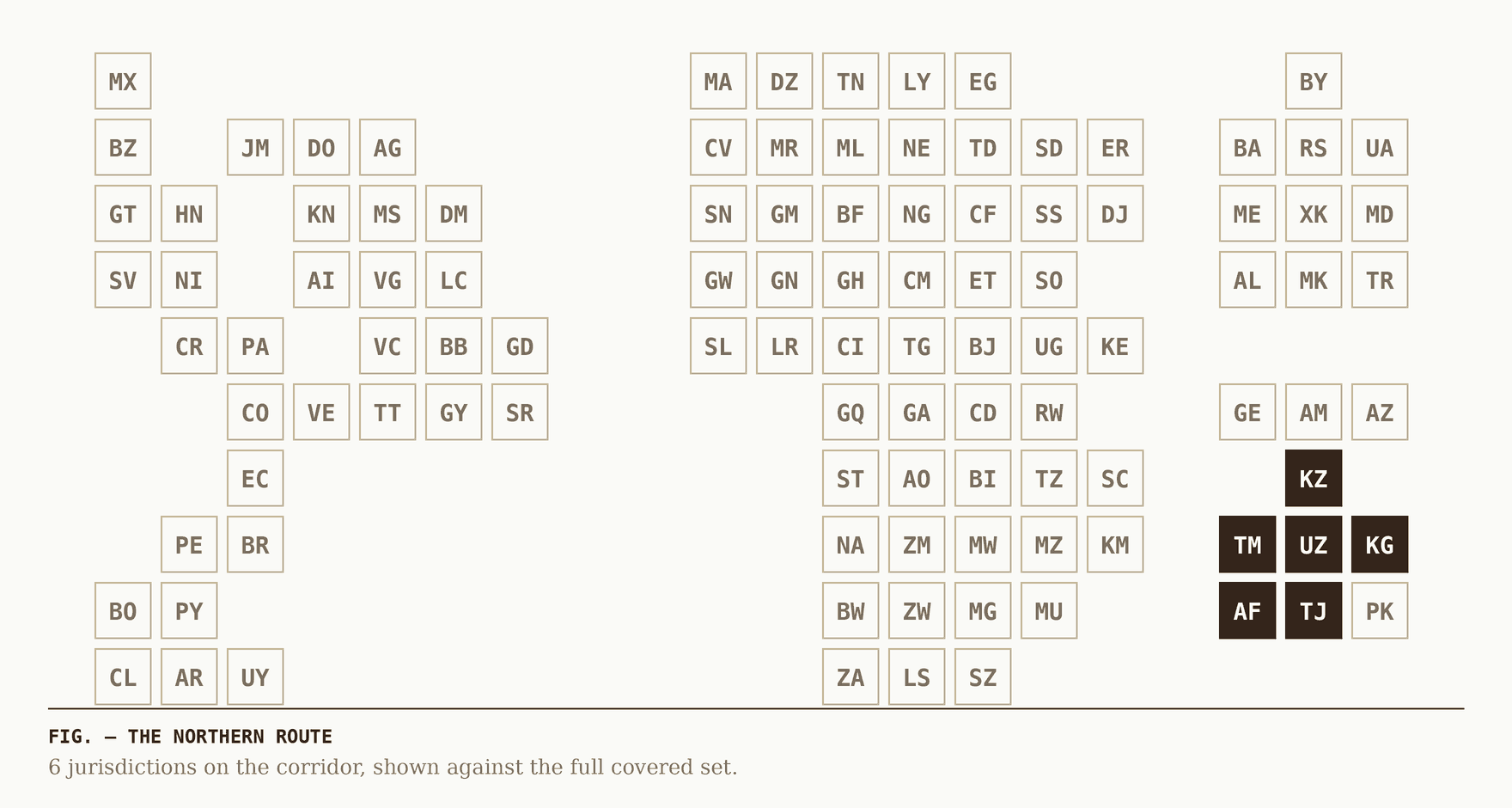
6 of the jurisdictions covered on this site: Afghanistan, Tajikistan, Uzbekistan, Kyrgyzstan, Turkmenistan, Kazakhstan. Each has a record setting out its treaty position, any national instrument confirmed against an official register, and its current standing in the monitoring process.
Is the legal framework consistent along this route?
No route in this dataset is uniform. On this one, 2 of the 6 legs are party to all four instruments, 4 are outside the Firearms Protocol, and 2 carry no national instrument confirmed against a citable register. Those differences are what a corridor exploits — the traffic settles where the combination is most permissive.
Which leg of the northern route is the weakest on the record?
On the three checks this dataset can apply — Firearms Protocol coverage, a confirmed national instrument and current monitoring status — Kyrgyzstan carries the most gaps of any leg on this corridor. That is a statement about what can be verified, not a ranking of enforcement: a jurisdiction that publishes little scores worse than one that publishes badly. The record for each leg sets out which of the three is missing and why.
What does the monitoring status add to that picture?
None of the legs on this corridor is currently under FATF increased monitoring. That is a statement about identified deficiencies in financial controls, not a finding that the route is well policed — the two are assessed by different processes against different standards.