Africa
Source tier A. Conventions checked 2026-07-29.
Drug and firearms law in Senegal: statutes on record and in force
Senegal, in Africa, is party to all four of the instruments tracked here, the last of them since 2006. It appears on neither FATF list. Its confirmed instrument on record is the Code Des Drogues Du 11 Novembre 1997. (Loi N°18/97) of 1997. The dates below are the depositary's; the instruments, where any are named, are the register's.
International framework
Senegal is bound by all four instruments this dataset tracks, the earliest from 1989 and the most recent from 2006.
| Instrument | Adopted | Ratified or acceded | Depositary reference |
|---|---|---|---|
| 1988 Convention | 1988 | 27 Nov 1989 | Chapter VI-19 |
| UNTOC | 2000 | 27 Oct 2003 | Chapter XVIII-12 |
| UNCAC | 2003 | 16 Nov 2005 | Chapter XVIII-14 |
| Firearms Protocol | 2001 | 7 Apr 2006 | Chapter XVIII-12-c |
What each instrument obliges a party to do is set out once, per instrument, in the conventions reference. The dates above are what is specific to Senegal: they are the points from which each obligation began to bind, taken from the depositary's own status tables.
National legislation
Each instrument below was located on an official register and is named exactly as that register names it, in the language of enactment.
Code Des Drogues Du 11 Novembre 1997. (Loi N°18/97) (No. 18/97) — A code rather than a dedicated statute: the offences sit within the general body of law and are read together with its provisions on attempt, participation and sentencing. Confirmed against the UNODC legal library, checked 2026-07-30.
Enforcement authorities
One body is named in the record for Senegal, each confirmed on Senegal's own government domain. The division of mandate is what decides where a case can actually be taken: interception, investigation and prosecution are three different powers, rarely held by one body.
| Body | Function | Confirmed on |
|---|---|---|
| Direction générale de la Police nationale | criminal investigation | policenationale.gouv.sn |
Ratification sequence
The dates below are worth reading as a sequence rather than as a set. Senegal came to these instruments over 17 years, beginning with the 1988 Convention in 1989 and ending with the Firearms Protocol in 2006. Measured against each instrument's own adoption, the shortest gap was the 1988 Convention at 1 year, the longest the Firearms Protocol at 5.
Senegal became a party to the 1988 Convention in 1989, 1 year after it was adopted — faster than the median lag of 5 years across this dataset.
The years in between are the ones a case from that period would have to be judged against. For the 14 years between 1989 and 2003, Senegal was bound by the 1988 Convention but not yet by the UNTOC, the UNCAC or the Firearms Protocol. Treaty obligations do not apply backwards, so the interval is a real limit on what the framework could reach at the time rather than an administrative detail.
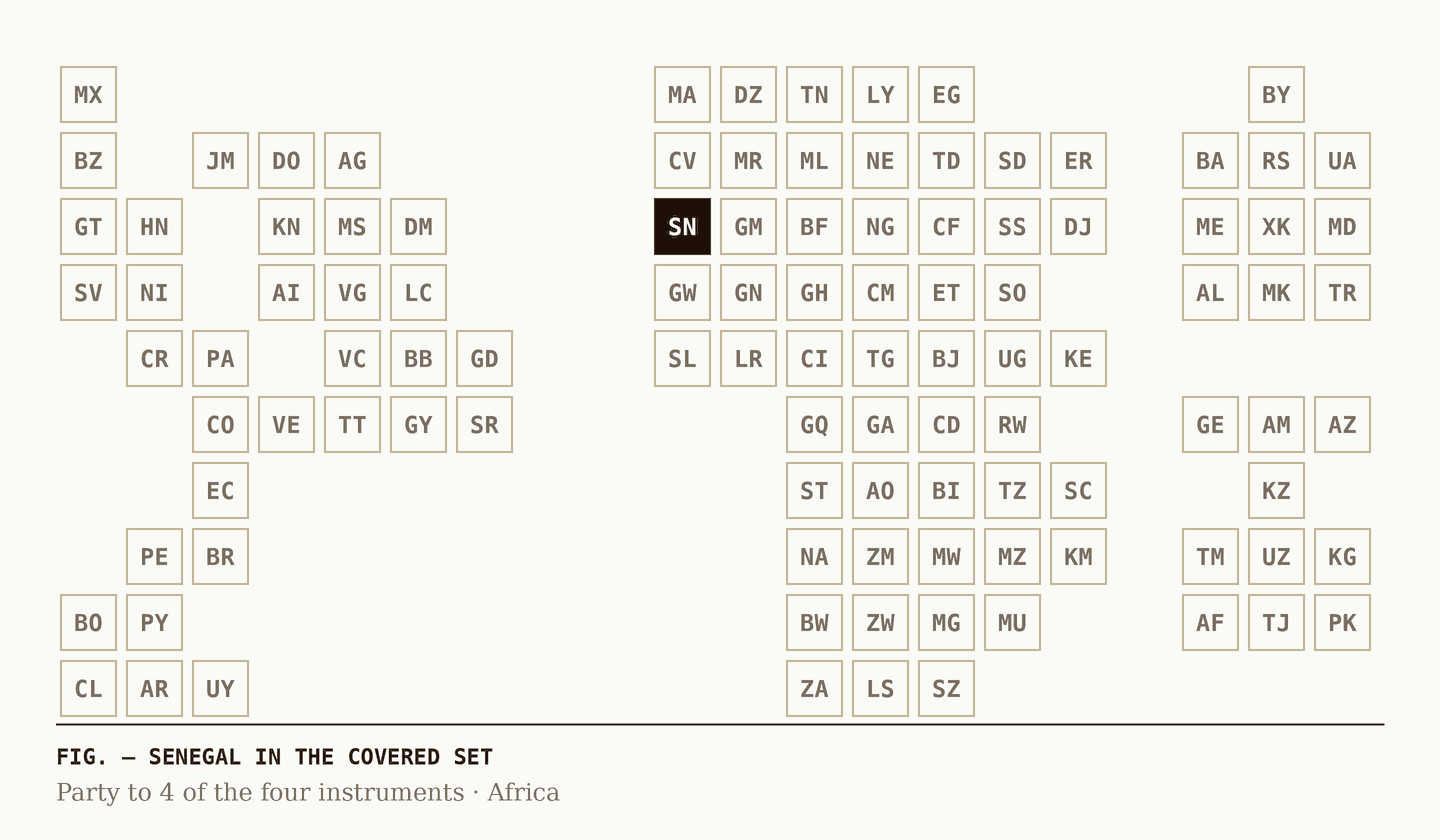
On coverage, Senegal is one of 81 jurisdiction s here party to 4 of the four, against 81 party to all four. Within Africa the dataset holds 53 jurisdictions, of which 6 are currently under FATF increased monitoring.
Position on the trafficking corridors
Senegal sits on the west african corridor, one of the six corridors profiled here. Its legal position on that route is the one set out on this page.
The West African corridor — 12 jurisdictions, carrying cocaine. The legs either side of Senegal in the reporting are Guinea and Gambia. Across the corridor as a whole, 9 of the 12 legs are party to all four instruments, 3 sit outside the Firearms Protocol, 1 carry no confirmed national instrument , and 1 is under increased monitoring. Senegal clears all three of those checks. The route page sets out every leg.
Financial-crime monitoring
As of the FATF plenary statements of 2026-06-19, Senegal is recorded as Not listed . Nothing here is a finding about Senegal's financial controls; it records only that neither statement names it. What each status entails is set out on the FATF grey list tracker.
Questions about drug and firearms law in Senegal
Which drug-control conventions has Senegal ratified?
All four: the 1988 Convention on 27 Nov 1989, the UNTOC on 27 Oct 2003, the UNCAC on 16 Nov 2005, the Firearms Protocol on 7 Apr 2006.
Is Senegal on the FATF grey list?
No. Senegal appears on neither the increased-monitoring list nor the call-for-action list in the FATF statements of 19 June 2026.
What national drug legislation is on record for Senegal?
Code Des Drogues Du 11 Novembre 1997. (Loi N°18/97) (No. 18/97), confirmed against the UNODC legal library.
Which register confirms the legislation on this page?
Each instrument names its own. For Senegal that is the UNODC legal library. Each link resolves to the register's own copy, not to a summary of it.
What is source tier A, and why is this record in it?
Tier A means a national instrument has been confirmed against an official register — for Senegal, 1 of them. The treaty dates and the listing status are separately sourced, so all three layers of this record carry a citation.
Why does the ratification date matter?
The date is the point from which the obligations bind. Senegal's earliest of these commitments dates from 1989, its most recent from 2006; the gap between them is a rough measure of how long the framework took to assemble.
Sources
- Ratification dates: United Nations Treaty Collection, depositary status tables (chapters VI-19, XVIII-12, XVIII-14, XVIII-12-c). Checked 2026-07-29.
- Listing status: FATF, Jurisdictions under Increased Monitoring and High-Risk Jurisdictions subject to a Call for Action, 2026-06-19.
- Code Des Drogues Du 11 Novembre 1997. (Loi N°18/97): the UNODC legal library, checked 2026-07-30.