Programme dossier
Led by its eighteen member states.
GAFILAT: Grupo de Acción Financiera de Latinoamérica on the record
The regional financial-monitoring body for Latin America — not a programme but the institution that assesses eighteen of the jurisdictions in this dataset.
What it addresses
GAFILAT is an intergovernmental body of regional membership grouping eighteen countries of South, Central and North America, created to prevent and combat money laundering, terrorist financing and the financing of proliferation. It belongs in this index for a structural reason rather than an operational one: the monitoring status recorded on every jurisdiction page is produced by a process, and for a substantial part of this dataset that process runs through this body rather than directly through the global task force. A reader who takes a listing at face value without knowing which body assessed it is missing the institution that did the work.
How it works
It is one of the regional groups of the global Financial Action Task Force and holds associate-member status with it, which means it participates in drafting, reviewing and amending the forty recommendations while also adhering to them. In practice its members commit to continuous improvement of national policy against these offences and to deepening the cooperation mechanisms between themselves — the mutual-evaluation model, in which states assess one another against a shared standard and publish the result. That is what makes a listing a finding about identified deficiencies rather than an opinion.
Where it applies
GAFILAT addresses 2 of the corridors described on the drug routes page: The Caribbean corridor, The Central American isthmus. The jurisdictions on each are listed there, and every one of them has a record setting out its treaty position, its confirmed national instruments and its current monitoring status.
That combination is what determines whether a programme of this kind can operate in a given place. Capacity-building assumes there is a legal power to build capacity around: an interdiction technique needs a statutory basis, a joint investigation needs a mutual legal assistance route, and a trace needs a record-keeping obligation. Where those are absent the constraint is legislative rather than operational.
Jurisdictions on those corridors — 20
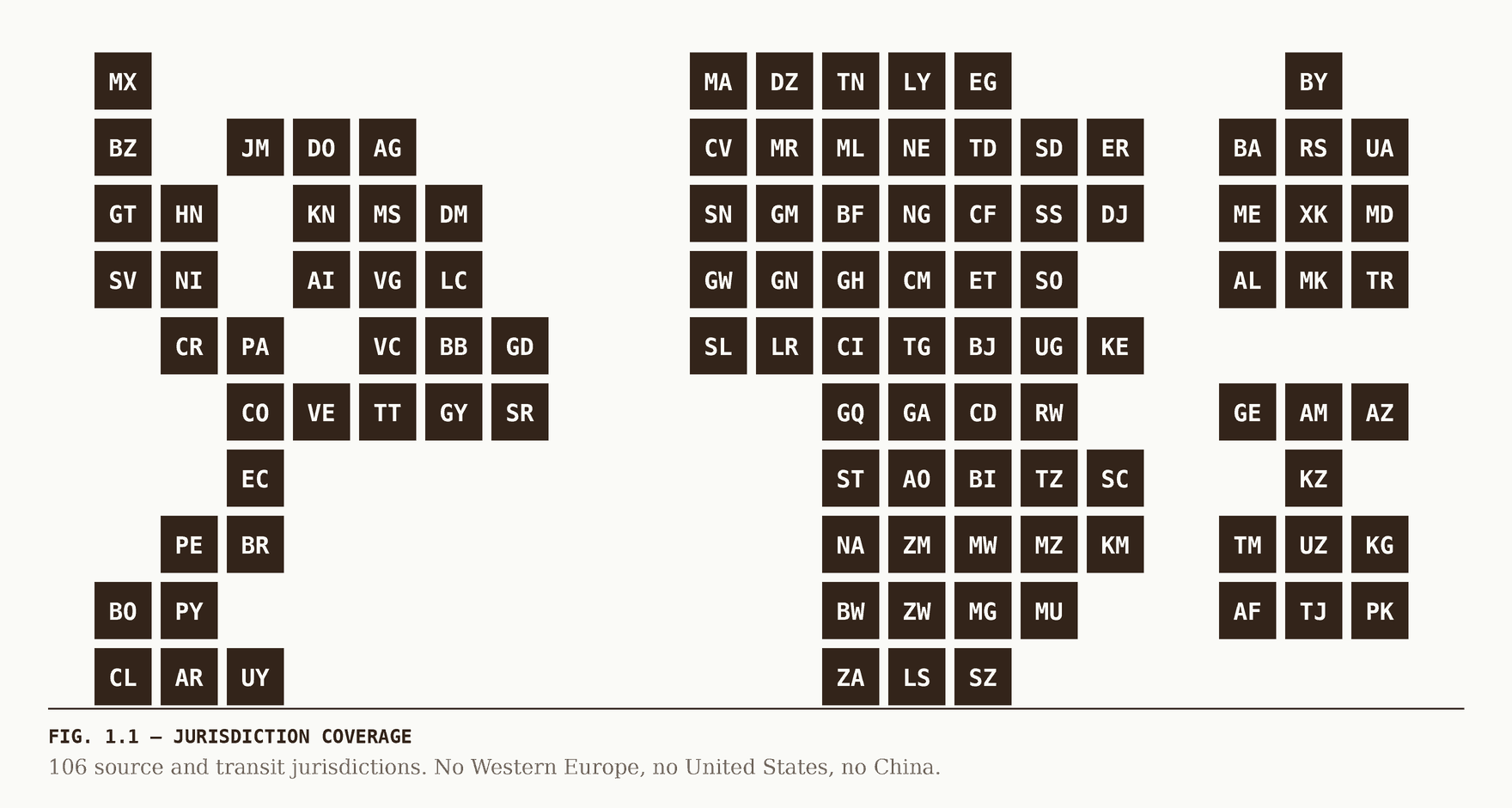
Anguilla · Antigua and Barbuda · Barbados · Belize · British Virgin Islands · Colombia · Costa Rica · Dominica · Dominican Republic · El Salvador · Guatemala · Honduras · Jamaica · Mexico · Nicaragua · Panama · Saint Lucia · Saint Vincent and the Grenadines · Trinidad and Tobago · Venezuela
This is the reach of the corridors GAFILAT addresses, not a list of participating states: participation is asserted by the inherited index and confirmed by no official source, so it is not published. What can be stated is which jurisdictions sit on the routes in question, and what the record shows about each.
Treaty basis
In substance the work operationalises not a treaty body: its standard is the forty recommendations rather than a convention, though the obligations it assesses against overlap heavily with the laundering and confiscation provisions of the 1988 Convention, UNTOC and UNCAC. The distinction matters: a programme of this kind creates no legal powers of its own. It builds the capacity of states to use powers they already hold under instruments they have ratified, which is why a jurisdiction that is not party to the relevant instrument gains less from participation than one that is. What each instrument obliges is set out on the conventions reference.
Questions
What was GAFILAT?
Grupo de Acción Financiera de Latinoamérica, led by its eighteen member states. The regional financial-monitoring body for Latin America — not a programme but the institution that assesses eighteen of the jurisdictions in this dataset. The description on this page is drawn from GAFILAT, which documents it.
What problem was GAFILAT designed to address?
GAFILAT is an intergovernmental body of regional membership grouping eighteen countries of South, Central and North America, created to prevent and combat money laundering, terrorist financing and the financing of proliferation. It belongs in this index for a structural reason rather than an operational one: the monitoring status recorded on every jurisdiction page is produced by a process, and for a substantial part of this dataset that process runs through this body rather than directly through the global task force. A reader who takes a listing at face value without knowing which body assessed it is missing the institution that did the work.
Which trafficking corridors does GAFILAT relate to?
The Caribbean corridor, The Central American isthmus. Those corridors and the jurisdictions on them are set out on the drug routes page.
What is the treaty basis for this kind of work?
In substance, not a treaty body: its standard is the forty recommendations rather than a convention, though the obligations it assesses against overlap heavily with the laundering and confiscation provisions of the 1988 Convention, UNTOC and UNCAC. A programme of this kind does not create legal powers; it builds the capacity to use powers a state already has under instruments it has ratified, which is why the ratification position on each jurisdiction record matters to what such a programme can achieve there.
Is GAFILAT still running?
This index does not assert a current operational state for any programme in it. Funding cycles turn over faster than the pages describing them, and a dossier that claimed a programme was active would be making a claim it could not keep current. GAFILAT is the place to check, and it is linked from the sources at the foot of this page.
Where does GAFILAT apply?
To the 20 jurisdictions on the corridors it addresses, each of which has a record here. Every one of them carries at least one national instrument confirmed against an official register. Participant lists are not published here — the inherited archive asserts them and no official source confirms them, so the reach given is the corridor reach.
Sources
- GAFILAT — Grupo de Acción Financiera de Latinoamérica . Checked 2026-07-30.