Comparison
10 jurisdictions · 3 regions.
Jurisdictions under increased monitoring: compared across the record
Listing is a finding about financial controls, not about drug enforcement, and the two are assessed by different processes against different standards. Comparing the listed set against its own treaty and statute record is therefore a check on whether the two kinds of weakness travel together — which, on this evidence, they do not reliably.
What the set looks like
10 jurisdictions fall into this set. 9 of 10 are party to all four instruments tracked here and 1 of 10 are outside the Firearms Protocol. 8 of 10 carry at least one national instrument confirmed against an official register, 8 of 10 name an enforcement authority confirmed on their own government domain, and 10 of 10 are currently under FATF increased monitoring.
A jurisdiction can hold a complete treaty position and a confirmed national statute and still be listed, because the deficiency identified is usually in beneficial-ownership transparency or in supervision of non-financial businesses rather than in the criminal law. Reading a listing as evidence that a state has weak drug legislation is the most common misuse of this status.
The comparison
| Jurisdiction | Region | Conventions | Instruments | FATF | Tier |
|---|---|---|---|---|---|
| Angola | Africa | 4 of 4 | 1 confirmed | Increased monitoring | A |
| Bolivia | Latin America and the Caribbean | 4 of 4 | 1 confirmed | Increased monitoring | A |
| Bosnia and Herzegovina | Balkans and eastern Europe | 4 of 4 | 1 confirmed | Increased monitoring | A |
| British Virgin Islands by extension from United Kingdom of Great Britain and Northern Ireland | Latin America and the Caribbean | 4 of 4 | 2 confirmed | Increased monitoring | C |
| Cameroon | Africa | 3 of 4 | 3 confirmed | Increased monitoring | A |
| Côte d'Ivoire | Africa | 4 of 4 | 1 confirmed | Increased monitoring | A |
| Democratic Republic of the Congo | Africa | 4 of 4 | none confirmed | Increased monitoring | B |
| Kenya | Africa | 4 of 4 | 3 confirmed | Increased monitoring | A |
| South Sudan | Africa | 4 of 4 | none confirmed | Increased monitoring | B |
| Venezuela | Latin America and the Caribbean | 4 of 4 | 3 confirmed | Increased monitoring | A |
Where the set diverges
A comparison earns its place by showing where members of a set differ, not where they agree. Across these 10 jurisdictions the ratifications recorded here span 35 years, from 1990 to 2025 — a range wide enough that the earliest and the latest were responding to different problems.
Treaty coverage. Cameroon is party to fewer than all four instruments, against 9 with the full set. On this measure the set is not uniform, and the gap is almost always the Firearms Protocol rather than one of the drug or organised-crime instruments.
Citable legislation. Democratic Republic of the Congo, South Sudan carry no national instrument confirmed against an official register, while 8 do. That is the widest split in most sets on this site, and it is a split in what can be sourced rather than in what exists.
Named authority. Angola, Democratic Republic of the Congo name no enforcement body confirmed on their own government domain. Since only a body's own domain is accepted as proof, this tracks how much of a jurisdiction's administration publishes on the open web as much as it tracks the administration itself.
How to read the columns
Conventions counts the four instruments the jurisdiction is party to, taken from the depositary's status tables. For a dependent territory the count reflects extension from the metropolitan state rather than its own accession. Instruments counts national statutes confirmed against an official register — never the number a jurisdiction has, only the number this dataset can cite. FATF is the listing status as of the most recent plenary statement, revised three times a year. Tier records which of those source paths applied.
The distinction that matters most here is between an empty cell and a zero. Nothing in this table asserts that a jurisdiction has no drug legislation; where the instruments column says none confirmed, it means no citable register published one that could be tied to that jurisdiction. The reasoning is set out under sources and methodology.
Questions
What do the FATF-listed jurisdictions in this dataset have in common?
Listing is a finding about financial controls, not about drug enforcement, and the two are assessed by different processes against different standards. Comparing the listed set against its own treaty and statute record is therefore a check on whether the two kinds of weakness travel together — which, on this evidence, they do not reliably. 10 jurisdictions in this dataset fall into the set.
How is this set selected?
By a property of the record rather than by editorial choice: membership follows from the treaty position, the tier, the listing status or the region as recorded, so the set changes when the underlying data changes. It currently holds 10 jurisdictions across 3 regions.
How does this set compare with the dataset as a whole?
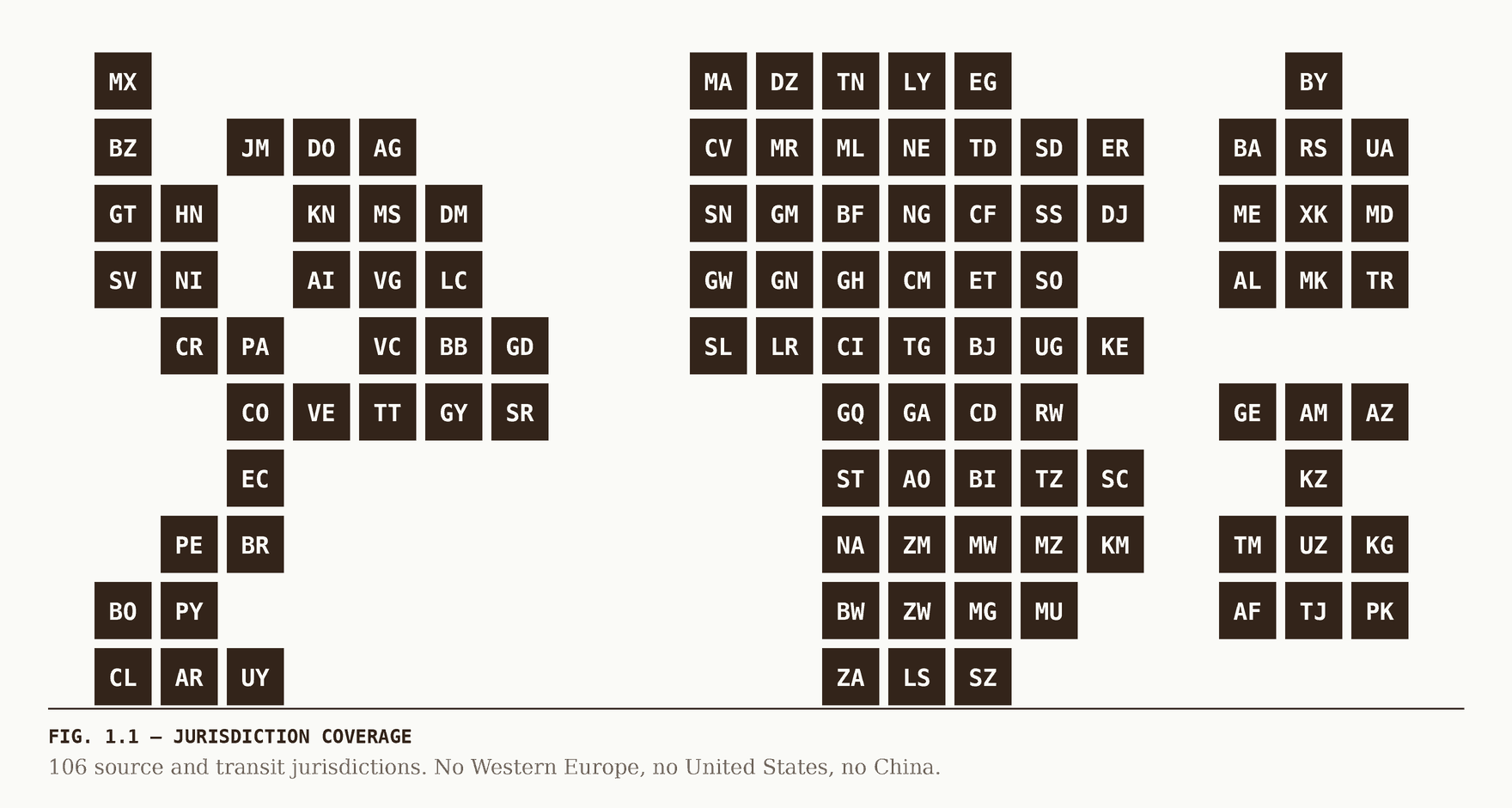
The full index holds 106 jurisdictions, so this set is 9% of it. Within the set, 9 are party to all four instruments against 81 across the whole index, and 8 carry a national instrument confirmed against an official register against 91 overall. A set that diverges from those proportions is where the comparison earns its place; one that matches them is telling you the property it was selected on does not travel with the others.
What can be concluded from a comparison like this?
A jurisdiction can hold a complete treaty position and a confirmed national statute and still be listed, because the deficiency identified is usually in beneficial-ownership transparency or in supervision of non-financial businesses rather than in the criminal law. Reading a listing as evidence that a state has weak drug legislation is the most common misuse of this status.