Concept guide
Who actually controls a company, as distinct from whose name is on the register.
Beneficial ownership: what it means and what it does not
The natural person who ultimately owns or controls a legal entity, or on whose behalf a transaction is conducted. It is distinct from legal ownership, which may rest with a nominee, a corporate shareholder in another jurisdiction, or a trust.
The misreading this term causes
The divergence between legal and beneficial ownership is normal and lawful in most of commerce, which is why "hidden ownership" is the wrong frame. The problem is not concealment as such but that a register recording only the legal owner answers a question nobody investigating a payment is asking.
This guide exists because of that misreading rather than because the term is unfamiliar. Most of the vocabulary in this subject is ordinary English used in a narrower sense, and the narrowing is exactly what gets lost when a term travels from a legal instrument into a summary of it.
How it works in practice
It is the single most cited deficiency in financial-monitoring assessments and the most frequently required reform before a jurisdiction is delisted. A register that exists but is unverified is only marginally better than none: if the declared beneficial owner is never checked against anything, the declaration is a formality that adds a document to the trail without adding a fact.
A worked case
A company registered in one jurisdiction is owned by a company in a second, whose shares are held by a nominee in a third. Every filing is accurate and every register is complete. An investigator following a payment reaches the first company, requests its ownership, receives the name of the second, and starts again — each step lawful, each step costing a mutual legal assistance request. The chain is not concealment in any actionable sense; it is three ordinary corporate structures whose combination answers a different question than the one being asked.
The case above is constructed rather than reported: it is the shortest arrangement of facts that produces the confusion this guide is about. Nothing in it is drawn from a specific investigation, and no jurisdiction is named, because the point is the structure rather than the instance.
What it governs in this dataset
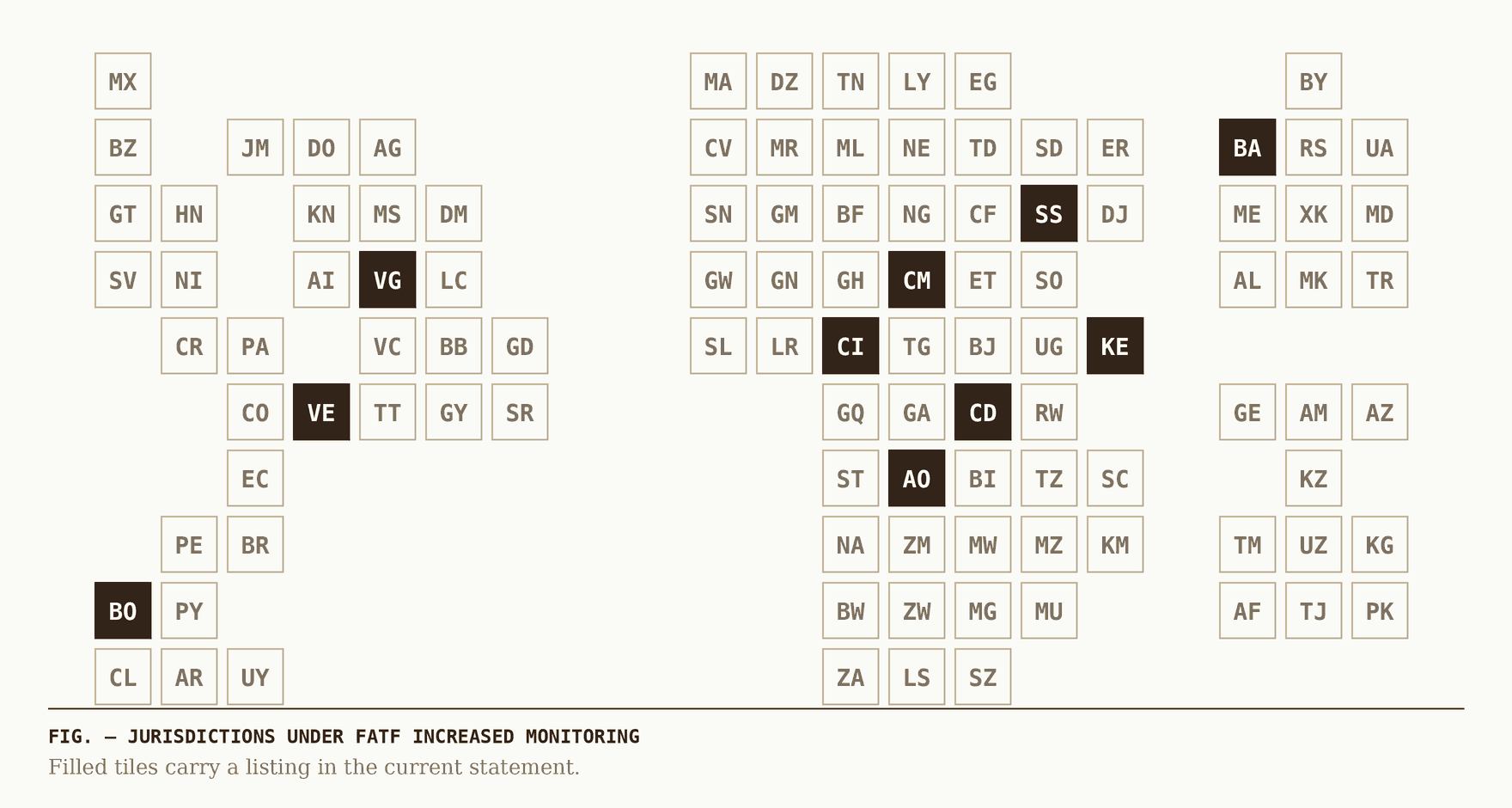
Monitoring status. 10 of 106 jurisdictions in this dataset are currently under increased monitoring. The concept is not an abstraction here: it determines what a record can state and how a reader should weigh it, and the figures move when the underlying sources do.
Where this appears: /fatf-grey-list/, and on every jurisdiction record in the index. How each layer is verified is set out under sources and methodology.
Questions
What does "beneficial ownership" mean?
The natural person who ultimately owns or controls a legal entity, or on whose behalf a transaction is conducted. It is distinct from legal ownership, which may rest with a nominee, a corporate shareholder in another jurisdiction, or a trust.
What is the common misreading of beneficial ownership?
The divergence between legal and beneficial ownership is normal and lawful in most of commerce, which is why "hidden ownership" is the wrong frame. The problem is not concealment as such but that a register recording only the legal owner answers a question nobody investigating a payment is asking.
How does beneficial ownership work out in practice?
It is the single most cited deficiency in financial-monitoring assessments and the most frequently required reform before a jurisdiction is delisted. A register that exists but is unverified is only marginally better than none: if the declared beneficial owner is never checked against anything, the declaration is a formality that adds a document to the trail without adding a fact.
Where does beneficial ownership show up in the jurisdiction records?
Monitoring status. 10 of 106 jurisdictions in this dataset are currently under increased monitoring. That figure is computed from the records rather than stated, so it moves when the underlying sources do.
Is there a worked example of beneficial ownership?
A company registered in one jurisdiction is owned by a company in a second, whose shares are held by a nominee in a third. Every filing is accurate and every register is complete. An investigator following a payment reaches the first company, requests its ownership, receives the name of the second, and starts again — each step lawful, each step costing a mutual legal assistance request. The chain is not concealment in any actionable sense; it is three ordinary corporate structures whose combination answers a different question than the one being asked. The case is constructed rather than reported — it is the shortest arrangement of facts that produces the confusion, and no jurisdiction is named because the point is the structure.
Related guides
- Ratification and implementation — Being bound by a treaty and having an offence a prosecutor can charge are different things.
- Predicate offence — Money laundering requires an underlying crime, and which crimes count is a national choice.
- Controlled delivery — The decision to let a detected consignment run rather than seizing it.