Concept guide
Money laundering requires an underlying crime, and which crimes count is a national choice.
Predicate offence: what it means and what it does not
A predicate offence is the crime that generated the proceeds a laundering charge concerns. Laundering is parasitic on it: without an underlying offence there are no criminal proceeds and nothing to launder, so every laundering prosecution has to establish one.
The misreading this term causes
Readers assume the list of predicate offences is standard. It is not. Some states enumerate a closed list, some use a penalty threshold, and the two approaches produce very different coverage — a threshold approach automatically captures new serious crimes as they are created, while an enumerated list has to be amended and often is not.
This guide exists because of that misreading rather than because the term is unfamiliar. Most of the vocabulary in this subject is ordinary English used in a narrower sense, and the narrowing is exactly what gets lost when a term travels from a legal instrument into a summary of it.
How it works in practice
This is where trade-based schemes and environmental cases most often fail. If a jurisdiction's laundering offence reaches only drug proceeds, money generated by customs fraud or illegal logging is outside it, and the prosecution has to fall back on the underlying offence alone — usually with far lower penalties and, critically, without access to the confiscation machinery the laundering offence carries.
A worked case
A container of goods is invoiced at three times its value and the difference settles in a second jurisdiction. The customs authority can show the price is wrong. Whether a laundering charge follows depends entirely on whether customs fraud is a predicate offence in that state: where the laundering provision lists drug trafficking and organised crime but not revenue offences, the money is not criminal proceeds as a matter of law, and the case reduces to an under-declaration penalty measured against the duty avoided rather than against the value moved.
The case above is constructed rather than reported: it is the shortest arrangement of facts that produces the confusion this guide is about. Nothing in it is drawn from a specific investigation, and no jurisdiction is named, because the point is the structure rather than the instance.
What it governs in this dataset
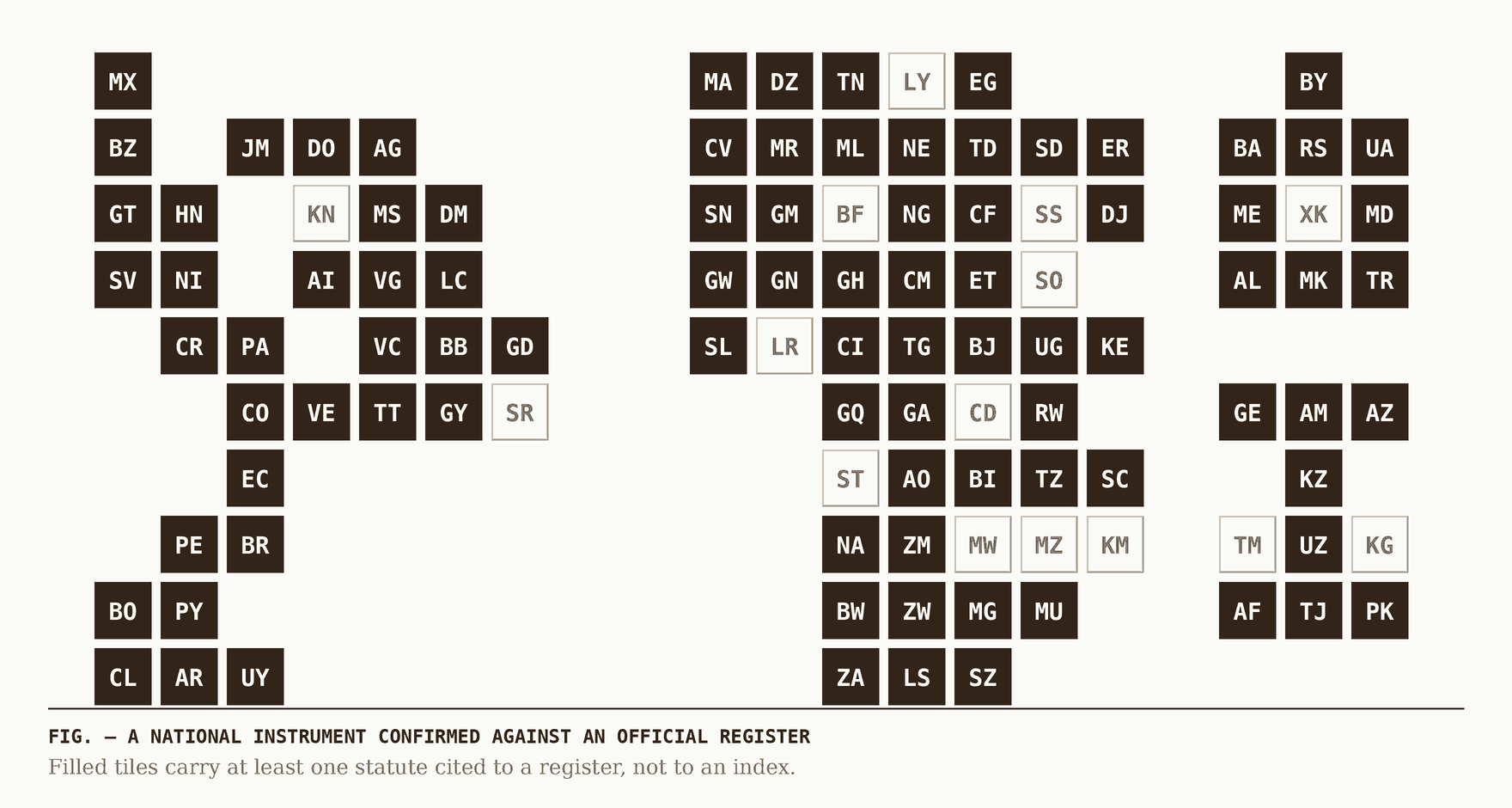
Confirmed national instruments. 91 of 106 jurisdictions carry at least one instrument confirmed against an official register, 161 in total. The concept is not an abstraction here: it determines what a record can state and how a reader should weigh it, and the figures move when the underlying sources do.
Where this appears: /methodology/, and on every jurisdiction record in the index. How each layer is verified is set out under sources and methodology.
Questions
What does "predicate offence" mean?
A predicate offence is the crime that generated the proceeds a laundering charge concerns. Laundering is parasitic on it: without an underlying offence there are no criminal proceeds and nothing to launder, so every laundering prosecution has to establish one.
What is the common misreading of predicate offence?
Readers assume the list of predicate offences is standard. It is not. Some states enumerate a closed list, some use a penalty threshold, and the two approaches produce very different coverage — a threshold approach automatically captures new serious crimes as they are created, while an enumerated list has to be amended and often is not.
How does predicate offence work out in practice?
This is where trade-based schemes and environmental cases most often fail. If a jurisdiction's laundering offence reaches only drug proceeds, money generated by customs fraud or illegal logging is outside it, and the prosecution has to fall back on the underlying offence alone — usually with far lower penalties and, critically, without access to the confiscation machinery the laundering offence carries.
Where does predicate offence show up in the jurisdiction records?
Confirmed national instruments. 91 of 106 jurisdictions carry at least one instrument confirmed against an official register, 161 in total. That figure is computed from the records rather than stated, so it moves when the underlying sources do.
Is there a worked example of predicate offence?
A container of goods is invoiced at three times its value and the difference settles in a second jurisdiction. The customs authority can show the price is wrong. Whether a laundering charge follows depends entirely on whether customs fraud is a predicate offence in that state: where the laundering provision lists drug trafficking and organised crime but not revenue offences, the money is not criminal proceeds as a matter of law, and the case reduces to an under-declaration penalty measured against the duty avoided rather than against the value moved. The case is constructed rather than reported — it is the shortest arrangement of facts that produces the confusion, and no jurisdiction is named because the point is the structure.
Related guides
- Ratification and implementation — Being bound by a treaty and having an offence a prosecutor can charge are different things.
- Controlled delivery — The decision to let a detected consignment run rather than seizing it.
- Beneficial ownership — Who actually controls a company, as distinct from whose name is on the register.