Concept guide
The decision to let a detected consignment run rather than seizing it.
Controlled delivery: what it means and what it does not
A technique in which authorities who have identified an illicit consignment permit it to continue to its destination under surveillance, so that arrests can be made at the point of receipt rather than at the point of discovery. Article 11 of the 1988 Convention obliges parties to permit its appropriate use internationally.
The misreading this term causes
It is often described as a surveillance tactic. It is better understood as a decision about what to optimise for: a seizure at the border produces a measurable result and identifies a courier, while a controlled delivery risks the consignment entirely in exchange for the possibility of reaching the organisers. The two objectives compete, and institutional incentives usually favour the first.
This guide exists because of that misreading rather than because the term is unfamiliar. Most of the vocabulary in this subject is ordinary English used in a narrower sense, and the narrowing is exactly what gets lost when a term travels from a legal instrument into a summary of it.
How it works in practice
The technique fails on cooperation rather than on tradecraft. It needs a second authority willing to let contraband transit its territory, a channel to arrange that quickly, and confidence that the counterpart will not seize the goods for its own statistics. Any one of those missing ends the operation before it starts.
A worked case
A port unit identifies a consignment in transit and has two options. Seize it, and the result is a recorded interception, a container, and at most the driver collecting it. Let it run, and the case may reach the receiving company, its ownership and the settlement route — or the consignment may simply vanish between two ports and the unit will have released contraband for nothing. The second option needs the next jurisdiction to agree in hours, which is why the technique is used far less than the treaty permitting it would suggest.
The case above is constructed rather than reported: it is the shortest arrangement of facts that produces the confusion this guide is about. Nothing in it is drawn from a specific investigation, and no jurisdiction is named, because the point is the structure rather than the instance.
What it governs in this dataset
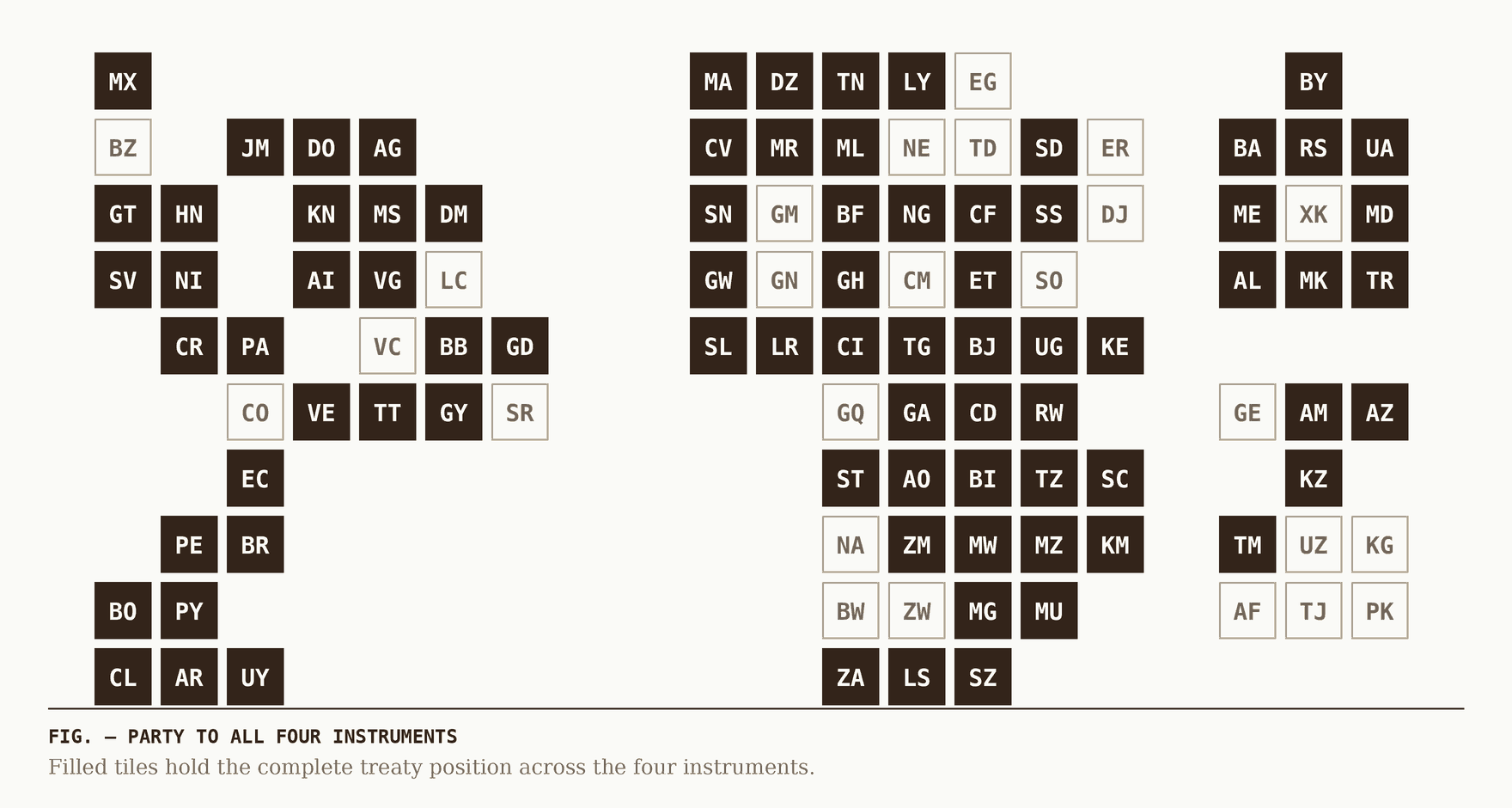
Treaty coverage. 81 of 106 jurisdictions are party to all four instruments; 23 are outside the Firearms Protocol. The concept is not an abstraction here: it determines what a record can state and how a reader should weigh it, and the figures move when the underlying sources do.
Where this appears: /countries/, and on every jurisdiction record in the index. How each layer is verified is set out under sources and methodology.
Questions
What does "controlled delivery" mean?
A technique in which authorities who have identified an illicit consignment permit it to continue to its destination under surveillance, so that arrests can be made at the point of receipt rather than at the point of discovery. Article 11 of the 1988 Convention obliges parties to permit its appropriate use internationally.
What is the common misreading of controlled delivery?
It is often described as a surveillance tactic. It is better understood as a decision about what to optimise for: a seizure at the border produces a measurable result and identifies a courier, while a controlled delivery risks the consignment entirely in exchange for the possibility of reaching the organisers. The two objectives compete, and institutional incentives usually favour the first.
How does controlled delivery work out in practice?
The technique fails on cooperation rather than on tradecraft. It needs a second authority willing to let contraband transit its territory, a channel to arrange that quickly, and confidence that the counterpart will not seize the goods for its own statistics. Any one of those missing ends the operation before it starts.
Where does controlled delivery show up in the jurisdiction records?
Treaty coverage. 81 of 106 jurisdictions are party to all four instruments; 23 are outside the Firearms Protocol. That figure is computed from the records rather than stated, so it moves when the underlying sources do.
Is there a worked example of controlled delivery?
A port unit identifies a consignment in transit and has two options. Seize it, and the result is a recorded interception, a container, and at most the driver collecting it. Let it run, and the case may reach the receiving company, its ownership and the settlement route — or the consignment may simply vanish between two ports and the unit will have released contraband for nothing. The second option needs the next jurisdiction to agree in hours, which is why the technique is used far less than the treaty permitting it would suggest. The case is constructed rather than reported — it is the shortest arrangement of facts that produces the confusion, and no jurisdiction is named because the point is the structure.
Related guides
- Ratification and implementation — Being bound by a treaty and having an offence a prosecutor can charge are different things.
- Predicate offence — Money laundering requires an underlying crime, and which crimes count is a national choice.
- Beneficial ownership — Who actually controls a company, as distinct from whose name is on the register.