Concept guide
Being bound by a treaty and having an offence a prosecutor can charge are different things.
Ratification and implementation: what it means and what it does not
Ratification is the act by which a state consents to be bound by a treaty, recorded by the depositary on a specific date. Implementation is the domestic legislation that turns that obligation into law a court can apply. The first is an international act with one authoritative record; the second is a national act with as many forms as there are legislatures.
The misreading this term causes
The two are treated as interchangeable constantly, and the substitution always runs the same way: a state is described as having criminalised something because it ratified an instrument requiring criminalisation. It may not have. A state can be party to all four instruments tracked here while its implementing statute is decades old, narrower than the convention, or absent for one category entirely.
This guide exists because of that misreading rather than because the term is unfamiliar. Most of the vocabulary in this subject is ordinary English used in a narrower sense, and the narrowing is exactly what gets lost when a term travels from a legal instrument into a summary of it.
How it works in practice
The gap has a direction. Ratification is cheap — it requires a decision and a deposited instrument — while implementation requires parliamentary time, drafting capacity and often a politically difficult debate about penalties. So the treaty position runs ahead of the statute book almost everywhere, which is why this dataset records them in separate columns and treats a confirmed national instrument as the harder fact.
A worked case
Take a state that deposited its instrument for the 1988 Convention in 1992 and whose principal drug statute dates from 1970. On the treaty record it has been bound to criminalise trafficking and to enable confiscation of proceeds for over three decades. In its own courts, the offences available are the ones the 1970 act created, drafted before the convention existed and before the substances now in circulation did. A prosecutor there works with the 1970 text, not with the convention, and a summary reporting the state as having criminalised laundering of drug proceeds since 1992 would be describing an obligation as though it were a statute.
The case above is constructed rather than reported: it is the shortest arrangement of facts that produces the confusion this guide is about. Nothing in it is drawn from a specific investigation, and no jurisdiction is named, because the point is the structure rather than the instance.
What it governs in this dataset
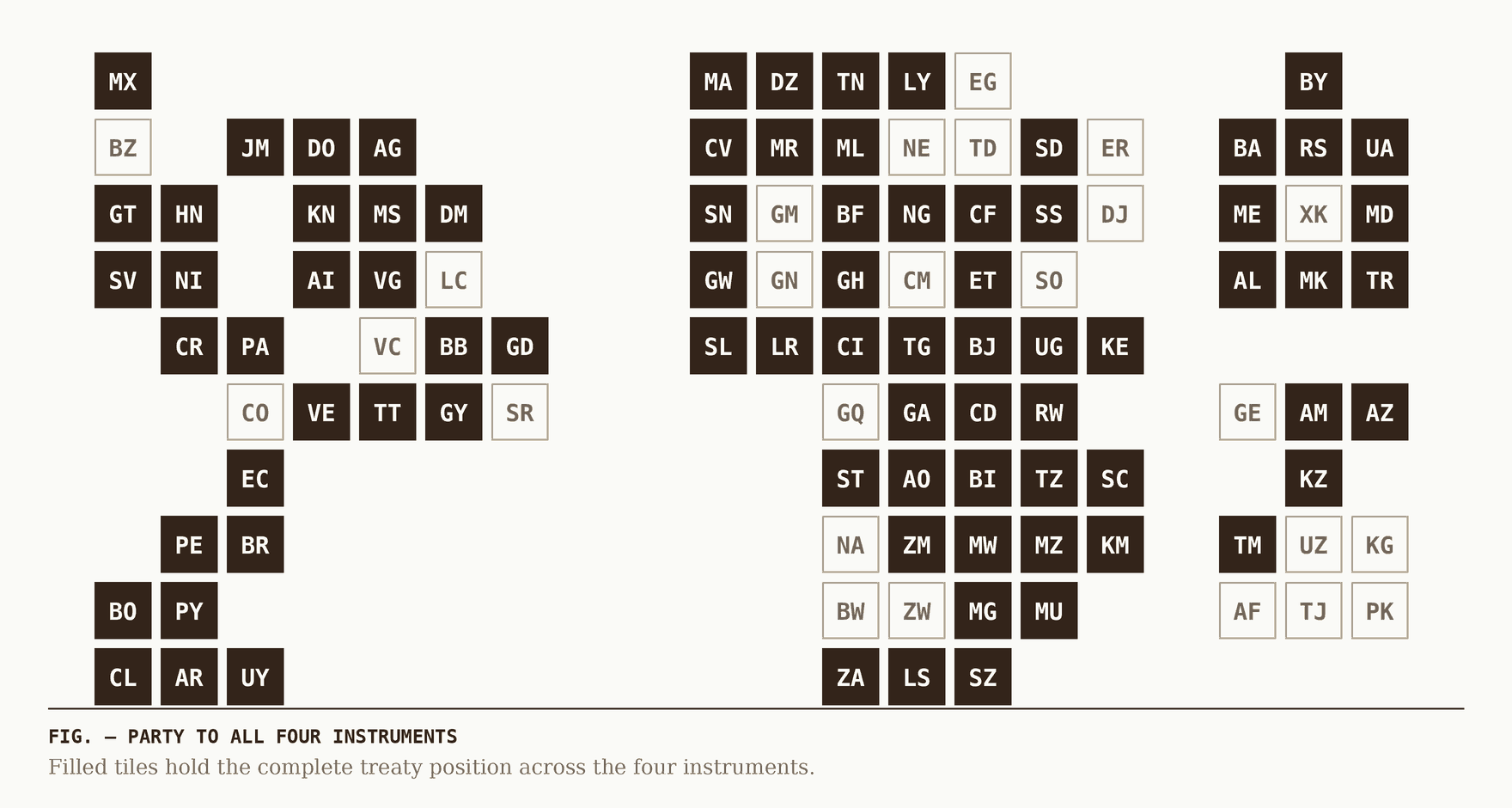
Treaty coverage. 81 of 106 jurisdictions are party to all four instruments; 23 are outside the Firearms Protocol. The concept is not an abstraction here: it determines what a record can state and how a reader should weigh it, and the figures move when the underlying sources do.
Where this appears: /countries/, and on every jurisdiction record in the index. How each layer is verified is set out under sources and methodology.
Questions
What does "ratification and implementation" mean?
Ratification is the act by which a state consents to be bound by a treaty, recorded by the depositary on a specific date. Implementation is the domestic legislation that turns that obligation into law a court can apply. The first is an international act with one authoritative record; the second is a national act with as many forms as there are legislatures.
What is the common misreading of ratification and implementation?
The two are treated as interchangeable constantly, and the substitution always runs the same way: a state is described as having criminalised something because it ratified an instrument requiring criminalisation. It may not have. A state can be party to all four instruments tracked here while its implementing statute is decades old, narrower than the convention, or absent for one category entirely.
How does ratification and implementation work out in practice?
The gap has a direction. Ratification is cheap — it requires a decision and a deposited instrument — while implementation requires parliamentary time, drafting capacity and often a politically difficult debate about penalties. So the treaty position runs ahead of the statute book almost everywhere, which is why this dataset records them in separate columns and treats a confirmed national instrument as the harder fact.
Where does ratification and implementation show up in the jurisdiction records?
Treaty coverage. 81 of 106 jurisdictions are party to all four instruments; 23 are outside the Firearms Protocol. That figure is computed from the records rather than stated, so it moves when the underlying sources do.
Is there a worked example of ratification and implementation?
Take a state that deposited its instrument for the 1988 Convention in 1992 and whose principal drug statute dates from 1970. On the treaty record it has been bound to criminalise trafficking and to enable confiscation of proceeds for over three decades. In its own courts, the offences available are the ones the 1970 act created, drafted before the convention existed and before the substances now in circulation did. A prosecutor there works with the 1970 text, not with the convention, and a summary reporting the state as having criminalised laundering of drug proceeds since 1992 would be describing an obligation as though it were a statute. The case is constructed rather than reported — it is the shortest arrangement of facts that produces the confusion, and no jurisdiction is named because the point is the structure.
Related guides
- Predicate offence — Money laundering requires an underlying crime, and which crimes count is a national choice.
- Controlled delivery — The decision to let a detected consignment run rather than seizing it.
- Beneficial ownership — Who actually controls a company, as distinct from whose name is on the register.