Concept guide
A supervisory status in a reform process, not a finding of bad faith.
Increased monitoring: what it means and what it does not
The status of a jurisdiction that has been assessed as having strategic deficiencies in its controls against money laundering and terrorist financing, and has agreed an action plan with deadlines to address them. It is revised three times a year.
The misreading this term causes
It is read as a blacklist entry, and it is not: a separate and much shorter call-for-action list carries that meaning. A jurisdiction under increased monitoring is inside the process and reporting against a plan. Being listed indicates a commitment to reform as much as it indicates a deficiency.
This guide exists because of that misreading rather than because the term is unfamiliar. Most of the vocabulary in this subject is ordinary English used in a narrower sense, and the narrowing is exactly what gets lost when a term travels from a legal instrument into a summary of it.
How it works in practice
The pressure is transmitted through correspondent banking. Institutions elsewhere apply enhanced due diligence to counterparties in a listed jurisdiction, which raises the cost and slows the speed of legitimate payments along with everything else. Delisting follows an on-site assessment, which is why it is a stronger signal than listing.
A worked case
Two jurisdictions on the same corridor: one is listed, one is not. The listed state has an action plan, deadlines, and reports at every plenary; the unlisted one has never been assessed as having strategic deficiencies, which is not the same as having none. Reading the pair as strong and weak inverts what the process says — the listed state is the one whose deficiencies have been identified, scheduled and are being reported against.
The case above is constructed rather than reported: it is the shortest arrangement of facts that produces the confusion this guide is about. Nothing in it is drawn from a specific investigation, and no jurisdiction is named, because the point is the structure rather than the instance.
What it governs in this dataset
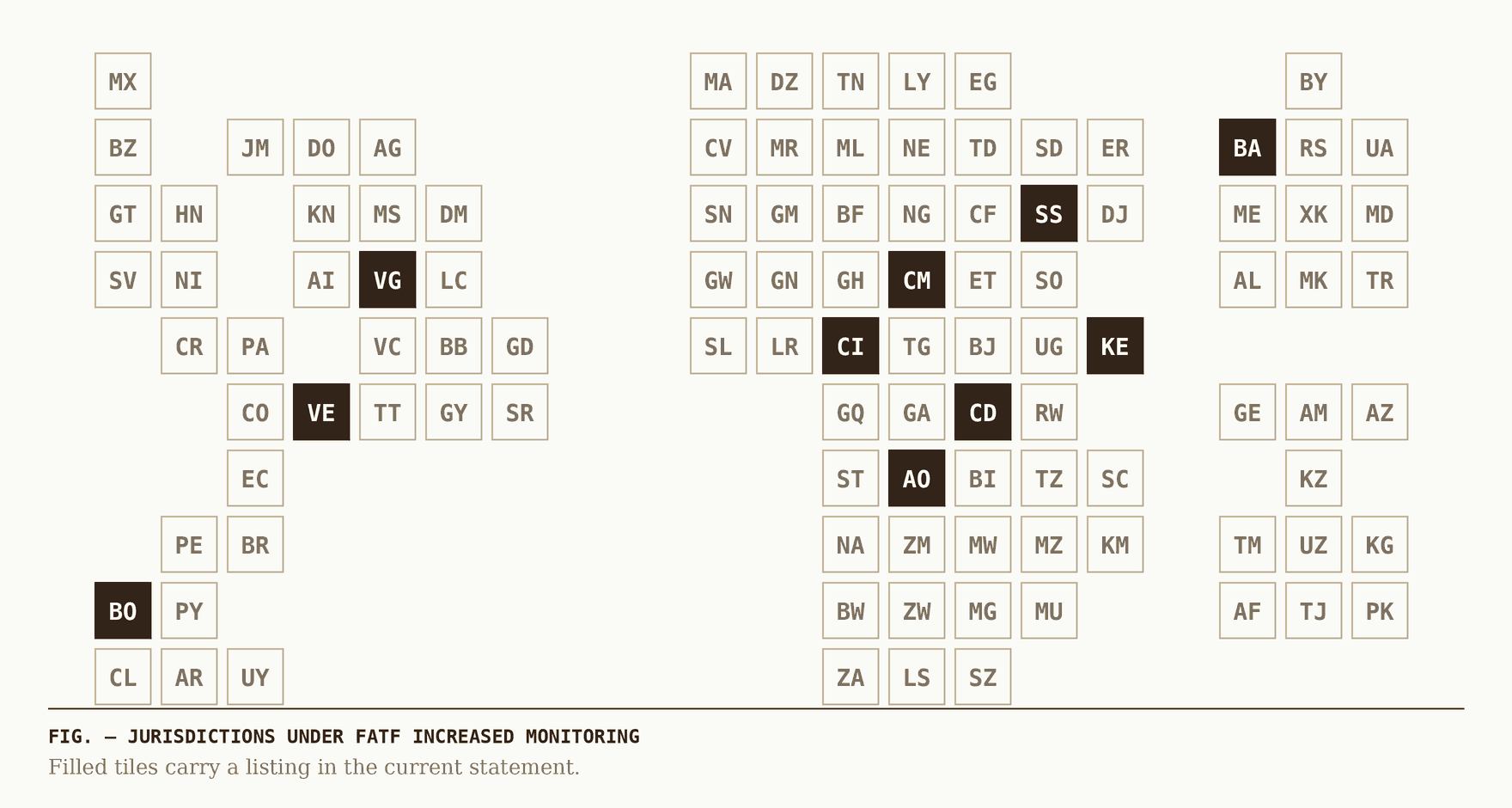
Monitoring status. 10 of 106 jurisdictions in this dataset are currently under increased monitoring. The concept is not an abstraction here: it determines what a record can state and how a reader should weigh it, and the figures move when the underlying sources do.
Where this appears: /fatf-grey-list/, and on every jurisdiction record in the index. How each layer is verified is set out under sources and methodology.
Questions
What does "increased monitoring" mean?
The status of a jurisdiction that has been assessed as having strategic deficiencies in its controls against money laundering and terrorist financing, and has agreed an action plan with deadlines to address them. It is revised three times a year.
What is the common misreading of increased monitoring?
It is read as a blacklist entry, and it is not: a separate and much shorter call-for-action list carries that meaning. A jurisdiction under increased monitoring is inside the process and reporting against a plan. Being listed indicates a commitment to reform as much as it indicates a deficiency.
How does increased monitoring work out in practice?
The pressure is transmitted through correspondent banking. Institutions elsewhere apply enhanced due diligence to counterparties in a listed jurisdiction, which raises the cost and slows the speed of legitimate payments along with everything else. Delisting follows an on-site assessment, which is why it is a stronger signal than listing.
Where does increased monitoring show up in the jurisdiction records?
Monitoring status. 10 of 106 jurisdictions in this dataset are currently under increased monitoring. That figure is computed from the records rather than stated, so it moves when the underlying sources do.
Is there a worked example of increased monitoring?
Two jurisdictions on the same corridor: one is listed, one is not. The listed state has an action plan, deadlines, and reports at every plenary; the unlisted one has never been assessed as having strategic deficiencies, which is not the same as having none. Reading the pair as strong and weak inverts what the process says — the listed state is the one whose deficiencies have been identified, scheduled and are being reported against. The case is constructed rather than reported — it is the shortest arrangement of facts that produces the confusion, and no jurisdiction is named because the point is the structure.
Related guides
- Ratification and implementation — Being bound by a treaty and having an offence a prosecutor can charge are different things.
- Predicate offence — Money laundering requires an underlying crime, and which crimes count is a national choice.
- Controlled delivery — The decision to let a detected consignment run rather than seizing it.