Concept guide
A weapon can only be traced back to where it left legal control if it was marked.
Marking and tracing: what it means and what it does not
Marking is the application of a unique identifier to a firearm at manufacture and at import. Tracing is the systematic reconstruction of a weapon's movement from manufacturer through licensed transfers to its last documented holder, which the mark makes possible.
The misreading this term causes
Tracing is imagined as a forensic technique. It is an administrative one: it works by querying records that someone was obliged to keep, and it stops the moment it reaches a jurisdiction, a dealer or a period where no such obligation existed.
This guide exists because of that misreading rather than because the term is unfamiliar. Most of the vocabulary in this subject is ordinary English used in a narrower sense, and the narrowing is exactly what gets lost when a term travels from a legal instrument into a summary of it.
How it works in practice
This is why a weapon with an intact mark is evidence about a supply chain while the same weapon without one is evidence only about the person holding it. It is also why a shared records system returns nothing for a jurisdiction with no marking obligation — and an accurate empty result is indistinguishable from a clean history.
A worked case
A firearm is recovered at a scene. Its mark identifies the manufacturer, and the manufacturer's records identify the export licence and the importing dealer. The trace runs cleanly to that point and stops, because the importing jurisdiction had no obligation to record onward transfers. The weapon's first twenty years are documented and its last five are not, and the five are the ones that matter. Nobody destroyed a record; the record was never required to exist.
The case above is constructed rather than reported: it is the shortest arrangement of facts that produces the confusion this guide is about. Nothing in it is drawn from a specific investigation, and no jurisdiction is named, because the point is the structure rather than the instance.
What it governs in this dataset
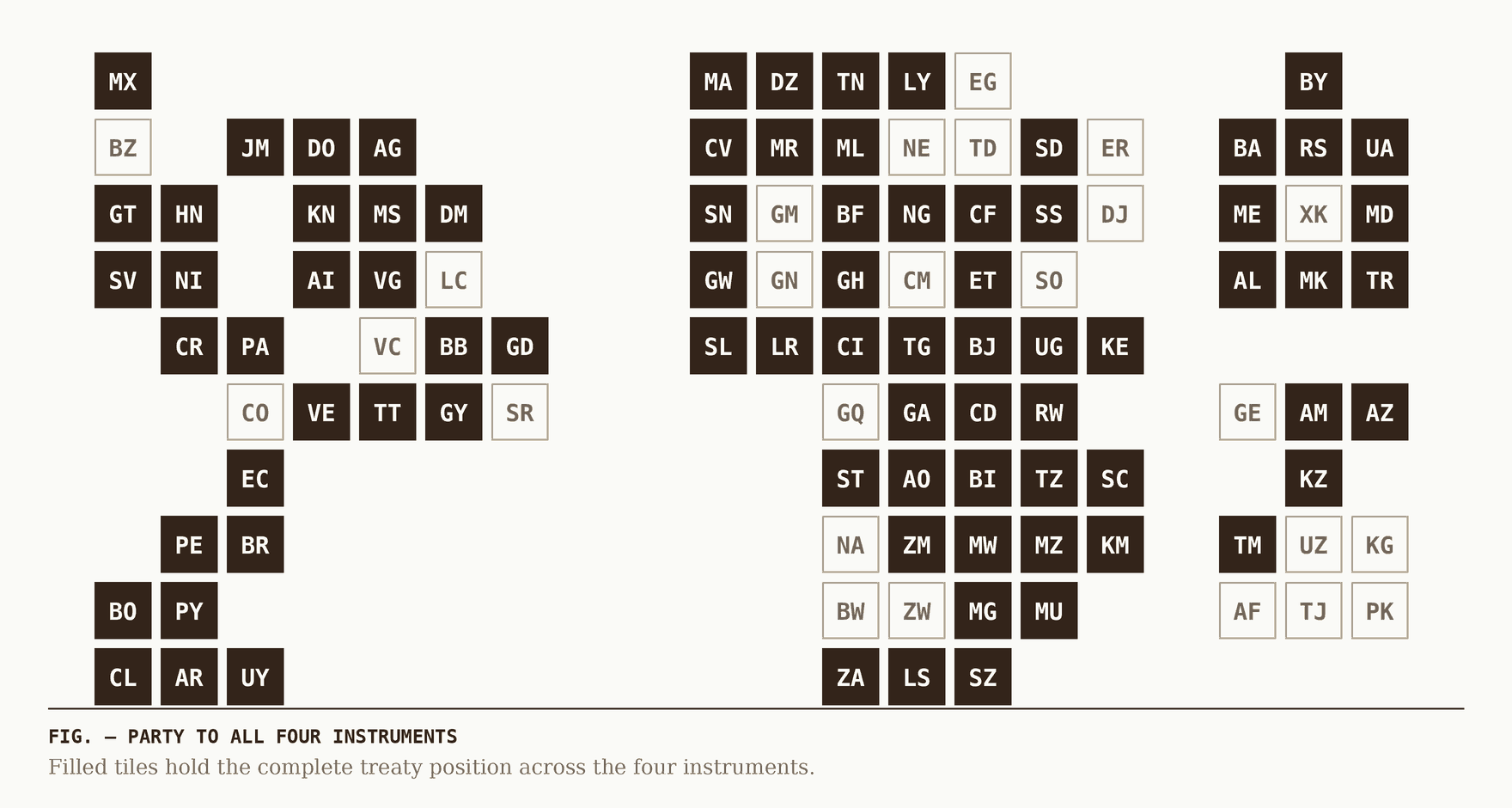
Treaty coverage. 81 of 106 jurisdictions are party to all four instruments; 23 are outside the Firearms Protocol. The concept is not an abstraction here: it determines what a record can state and how a reader should weigh it, and the figures move when the underlying sources do.
Where this appears: /countries/, and on every jurisdiction record in the index. How each layer is verified is set out under sources and methodology.
Questions
What does "marking and tracing" mean?
Marking is the application of a unique identifier to a firearm at manufacture and at import. Tracing is the systematic reconstruction of a weapon's movement from manufacturer through licensed transfers to its last documented holder, which the mark makes possible.
What is the common misreading of marking and tracing?
Tracing is imagined as a forensic technique. It is an administrative one: it works by querying records that someone was obliged to keep, and it stops the moment it reaches a jurisdiction, a dealer or a period where no such obligation existed.
How does marking and tracing work out in practice?
This is why a weapon with an intact mark is evidence about a supply chain while the same weapon without one is evidence only about the person holding it. It is also why a shared records system returns nothing for a jurisdiction with no marking obligation — and an accurate empty result is indistinguishable from a clean history.
Where does marking and tracing show up in the jurisdiction records?
Treaty coverage. 81 of 106 jurisdictions are party to all four instruments; 23 are outside the Firearms Protocol. That figure is computed from the records rather than stated, so it moves when the underlying sources do.
Is there a worked example of marking and tracing?
A firearm is recovered at a scene. Its mark identifies the manufacturer, and the manufacturer's records identify the export licence and the importing dealer. The trace runs cleanly to that point and stops, because the importing jurisdiction had no obligation to record onward transfers. The weapon's first twenty years are documented and its last five are not, and the five are the ones that matter. Nobody destroyed a record; the record was never required to exist. The case is constructed rather than reported — it is the shortest arrangement of facts that produces the confusion, and no jurisdiction is named because the point is the structure.
Related guides
- Ratification and implementation — Being bound by a treaty and having an offence a prosecutor can charge are different things.
- Predicate offence — Money laundering requires an underlying crime, and which crimes count is a national choice.
- Controlled delivery — The decision to let a detected consignment run rather than seizing it.