Concept guide
How a dependent territory becomes bound without acceding itself.
Extension of treaty: what it means and what it does not
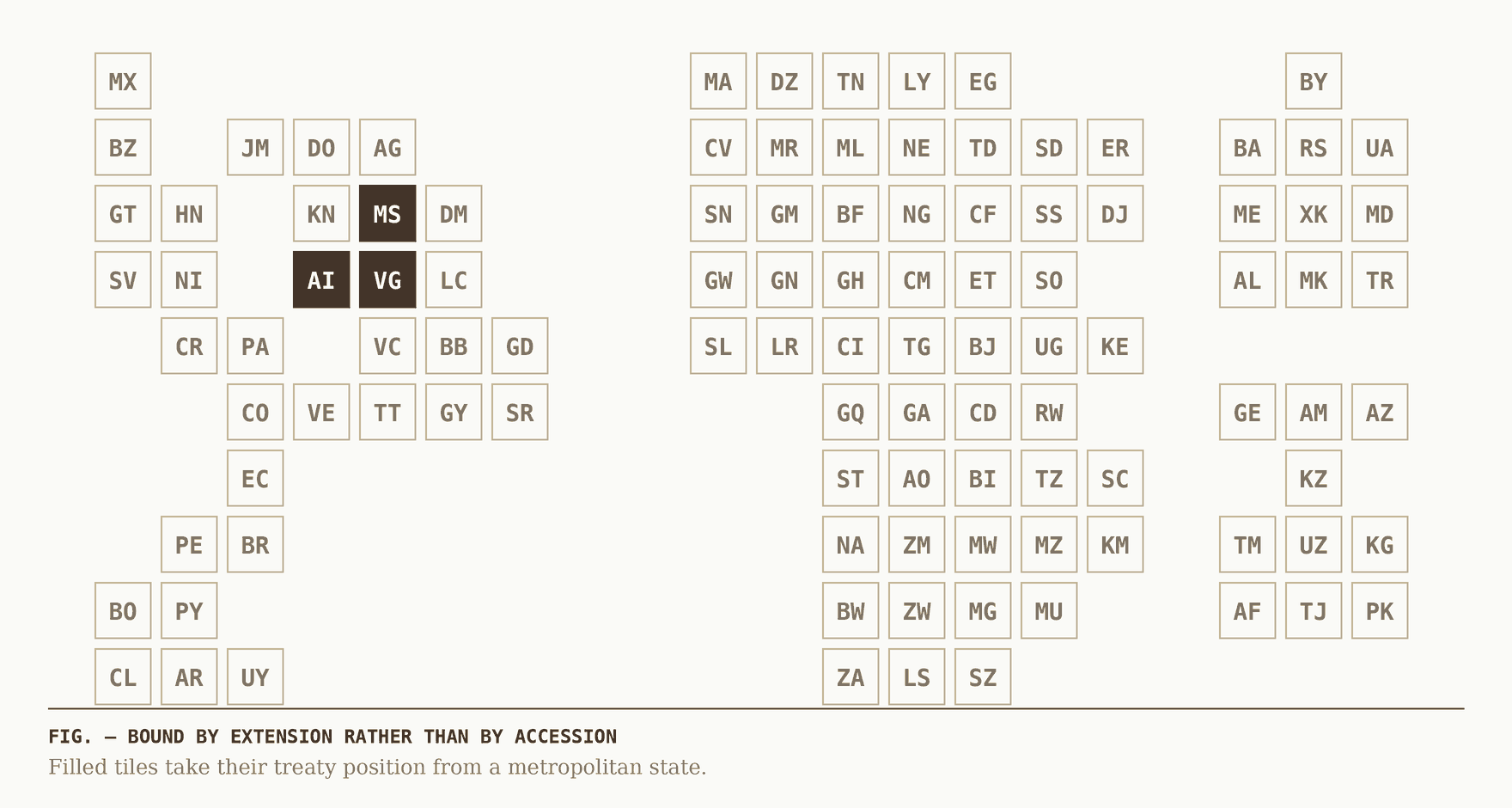
The mechanism by which a metropolitan state declares that a treaty it has ratified applies to a territory for whose international relations it is responsible. The territory is bound, on the metropolitan state's date, without being a party in its own right.
The misreading this term causes
Because these territories never appear in a depositary participant list, an exact-match search reports them as having ratified nothing. That is the single most common data error in this subject area, and it converts a territory with full treaty coverage into an apparent hole in the map.
This guide exists because of that misreading rather than because the term is unfamiliar. Most of the vocabulary in this subject is ordinary English used in a narrower sense, and the narrowing is exactly what gets lost when a term travels from a legal instrument into a summary of it.
How it works in practice
The complication that remains is which legislature implements. Implementing law may sit in the metropolitan statute book, in locally enacted ordinances, or in both, and the division is rarely documented in one place — which is why records in this category carry the treaty position confidently and the statute position cautiously.
A worked case
A search of the depositary's participant list for a Caribbean territory returns nothing for all four instruments. Read literally, the territory has ratified none of them. In fact the United Kingdom's ratifications extend to it, so all four apply, on the United Kingdom's dates. A dataset built by exact-name matching would record four gaps where there are none — and would then rank that territory as the weakest link on a corridor whose treaty coverage is in fact complete.
The case above is constructed rather than reported: it is the shortest arrangement of facts that produces the confusion this guide is about. Nothing in it is drawn from a specific investigation, and no jurisdiction is named, because the point is the structure rather than the instance.
What it governs in this dataset
Territories bound by extension. 3 jurisdictions in this dataset take their obligations by extension rather than by their own accession. The concept is not an abstraction here: it determines what a record can state and how a reader should weigh it, and the figures move when the underlying sources do.
Where this appears: /compare/dependent-territories/, and on every jurisdiction record in the index. How each layer is verified is set out under sources and methodology.
Questions
What does "extension of treaty" mean?
The mechanism by which a metropolitan state declares that a treaty it has ratified applies to a territory for whose international relations it is responsible. The territory is bound, on the metropolitan state's date, without being a party in its own right.
What is the common misreading of extension of treaty?
Because these territories never appear in a depositary participant list, an exact-match search reports them as having ratified nothing. That is the single most common data error in this subject area, and it converts a territory with full treaty coverage into an apparent hole in the map.
How does extension of treaty work out in practice?
The complication that remains is which legislature implements. Implementing law may sit in the metropolitan statute book, in locally enacted ordinances, or in both, and the division is rarely documented in one place — which is why records in this category carry the treaty position confidently and the statute position cautiously.
Where does extension of treaty show up in the jurisdiction records?
Territories bound by extension. 3 jurisdictions in this dataset take their obligations by extension rather than by their own accession. That figure is computed from the records rather than stated, so it moves when the underlying sources do.
Is there a worked example of extension of treaty?
A search of the depositary's participant list for a Caribbean territory returns nothing for all four instruments. Read literally, the territory has ratified none of them. In fact the United Kingdom's ratifications extend to it, so all four apply, on the United Kingdom's dates. A dataset built by exact-name matching would record four gaps where there are none — and would then rank that territory as the weakest link on a corridor whose treaty coverage is in fact complete. The case is constructed rather than reported — it is the shortest arrangement of facts that produces the confusion, and no jurisdiction is named because the point is the structure.
Related guides
- Ratification and implementation — Being bound by a treaty and having an offence a prosecutor can charge are different things.
- Predicate offence — Money laundering requires an underlying crime, and which crimes count is a national choice.
- Controlled delivery — The decision to let a detected consignment run rather than seizing it.